Nectar AI vs Candy AI for Roleplay: Which Is Better for Chat and Images?

Last updated: August 19, 2026

Nectar AI vs Candy AI for Roleplay: Which Is Better for Chat and Images?

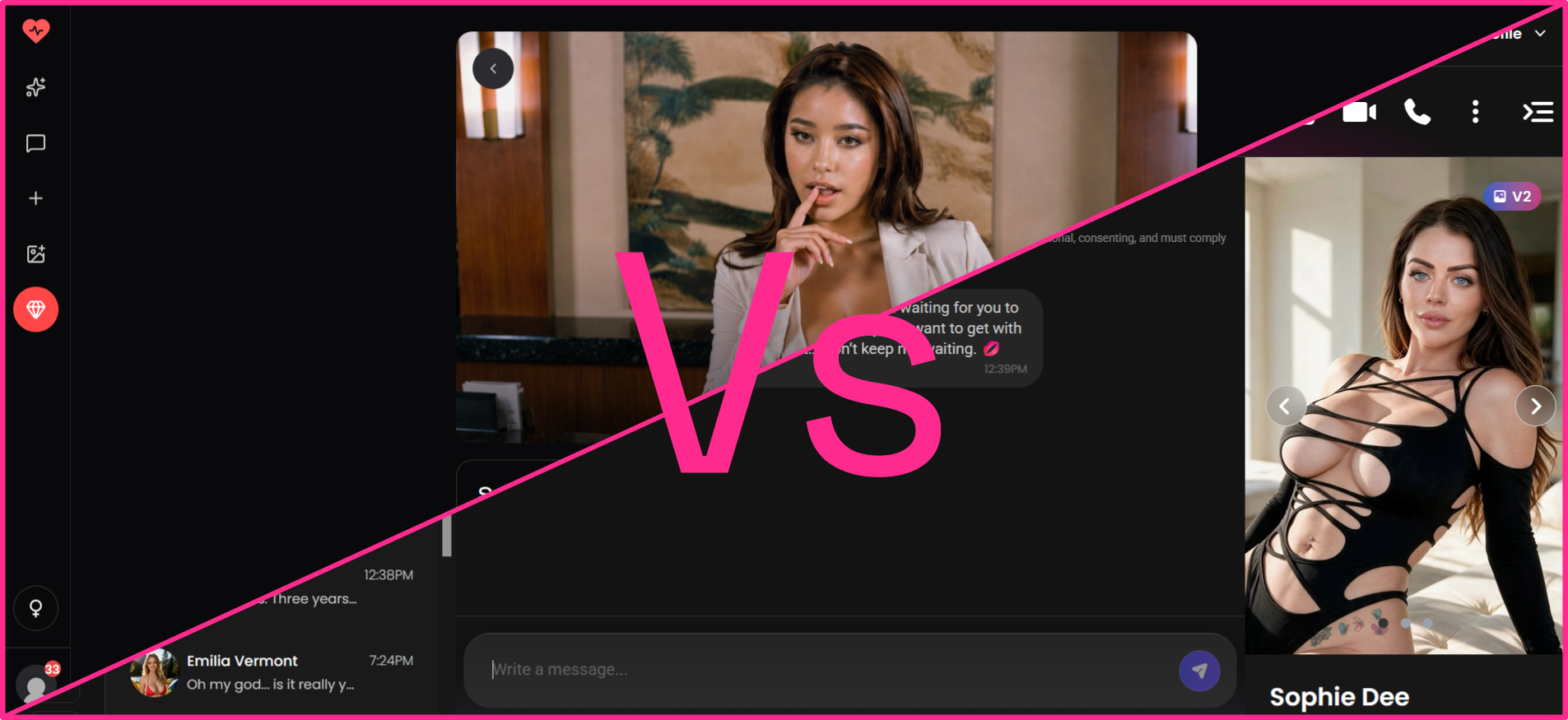
Candy AI vs Nectar

FeatureCandy AINectarWinner
Conversation quality⭐⭐⭐⭐½⭐⭐⭐⭐⭐Nectar
Memory & continuity⭐⭐⭐⭐⭐⭐⭐⭐⭐Nectar
Personality customization⭐⭐⭐⭐½⭐⭐⭐⭐⭐Nectar
Roleplay⭐⭐⭐⭐½⭐⭐⭐⭐⭐Nectar
Image generation⭐⭐⭐⭐⭐⭐⭐⭐⭐½Candy AI
Video generation⭐⭐⭐⭐⭐⭐⭐⭐½Candy AI
Voice conversations⭐⭐⭐⭐½⭐⭐⭐⭐Candy AI
Character creation⭐⭐⭐⭐½⭐⭐⭐⭐⭐Nectar
Ease of use⭐⭐⭐⭐⭐⭐⭐⭐⭐½Candy AI
Long-term relationships⭐⭐⭐⭐⭐⭐⭐⭐⭐Nectar
Visual contentExcellentVery GoodCandy AI
Deep relationshipsVery GoodExcellentNectar
Best for beginnersVery GoodGoodCandy AI
Best overall8.5/109.0/10Nectar

Candy AI and Nectar are both good, but they have slightly different strengths. Candy AI is better for images, video and ease of use, so it makes more sense if you want to browse characters and get plenty of visual content without spending ages setting everything up.

Nectar is better for conversation, roleplay and creating a more personalised companion, especially if you want to spend more time developing the character and the relationship.

Want to try Candy AI? Check out Candy AI here.
Prefer stronger conversation and better character development? Try Nectar here

Testing methodology

I spent several days putting this app through its paces, trying out the available features and comparing the free and premium experience. I tested everything from everyday usability and customization to performance, pricing, and how consistent the app is over time. This review is based on hands-on use and my personal experience.

What is Nectar AI

Nectar seems to put more emphasis on creating and customizing your own AI companion, while Candy AI feels more focused on the wider content and entertainment side of things.

Nectar is very much built around the idea of creating an AI girlfriend that fits what you’re looking for. You can customize the character, personality and the way you interact with her, then build up the relationship through ongoing chats and roleplay.

That said, Nectar isn’t just about creating your own character. It also has a large selection of pre-made companions and fantasy scenarios, so you can simply choose someone and get started without creating everything from scratch.

What is Candy AI

Candy AI leans harder into the visual side—sharper photorealistic images, short moving clips, and that quick “wow, she actually looks good” feeling when you generate stuff—while Nectar AI is more about the conversation itself, with smoother roleplay flow, deeper character customization for storytelling, and better long-chat immersion that keeps the talk feeling natural and continuous.

As with Nectar It’s made for adults who want uncensored roleplay, flirty conversations, or just some private companionship, and the characters can remember stuff you’ve talked about so it feels a bit more ongoing. You can jump in with ready-made ones or build your own from looks and personality down to the details, all without leaving your browser.

My real testing experience

I ran both apps side by side for a couple of weeks, using the same roleplay prompts and image requests so the differences would show up clearly.

With Nectar the chat usually felt smoother once a scene got going. I’d start a longer roleplay, throw in some back-and-forth details, and the character would keep the thread without me having to remind it every few messages. The downside showed up when I asked for images mid-scene. The faces often drifted a bit from one generation to the next, and sometimes the outfit or lighting just didn’t match what we’d been talking about. It was usable, but it broke the immersion more than I liked.

If you want the full breakdown of how Nectar handles longer conversations and memory, I covered it in more detail in my Nectar AI Review 2026: Is It Worth It?

Candy was the opposite. The images came out sharper and more consistent with the character’s look, and the short video clips actually added something when a scene called for it. The problem was the conversation side. After twenty or thirty messages the character would start dropping earlier details or filling in gaps with stuff I never said. One night I had a longer roleplay going and by the end it had completely forgotten a key preference I’d mentioned at the start. The visuals stayed strong, but the chat started feeling thinner the longer it went.

If you want the full breakdown of Candy’s image quality, pricing, and overall experience, I covered it here: Candy AI Review (2026): Is It Worth It? Features, Pricing & Pros and Cons

Neither one is perfect. Nectar keeps the talk feeling more real for longer but the pictures can let you down. Candy looks better in the moment but the conversation doesn’t hold up as well once you push past a single scene.

Features Breakdown

Memory

Candy’s visual memory is excellent — the character’s look stays locked in. Conversational memory is the weak spot. Several long-term users reported that after a week or so of regular chatting, smaller details started disappearing. One preference mentioned early on in the conversation was completely gone by the end of a longer session.

Nectar tends to hold onto important facts a bit better in medium-length roleplay, but it still has a ceiling. A few people who pushed past fifty messages noticed the character starting to gloss over earlier plot points.

It held onto the important stuff better than a lot of apps I’ve tried. Names, key preferences, and the overall vibe from earlier sessions would come back without me prompting. That part worked. The ceiling became obvious after a few days of the same ongoing story. Smaller details started getting glossed over, and once or twice it filled in gaps with things I never said.

Personality

Candy’s characters start with a clear vibe. You pick traits like shy, confident, playful or dominant and the early replies usually match. In shorter chats it feels consistent enough. The problem is that over longer roleplay the personality can soften. A few times I had a character that was meant to be sarcastic and it slowly drifted into something more generic and agreeable the longer the conversation went.

Nectar lets you dig in more with the personality side. The sliders and backstory options actually change how the character talks. I built one as assertive and a bit sharp, and another as soft and careful, and they responded differently to the same prompts. In medium-length sessions the personality held better. It still isn’t perfect — after a long stretch some of the sharper edges can fade — but it felt more like the character I had set up stayed closer to that setup for longer.

Chat & Roleplay

Candy started strong every time. The first ten or fifteen messages felt lively and the character stayed in the moment without much effort on my part. Once I pushed into longer roleplay though, things started to slip.

After about twenty or thirty messages it would drop details I’d already mentioned or fill in gaps with stuff that never happened. One night I had a scene going for a while and by the end the character had completely forgotten a preference I’d set at the start. The energy stayed high, but the continuity got thinner the longer we went.

Once Nectar got going the conversation usually felt smoother than I expected. I’d set up a longer roleplay, add details as we went, and the character would keep the thread without me having to re-explain everything every few messages. Emotional tone held up pretty well too. The weak spot showed up when I pushed past a longer stretch — around the 40–50 message mark the replies started to loop a bit or lose smaller plot points I’d established earlier.

NSFW

Both apps handle adult content without the constant interruptions you get on mainstream platforms. I didn’t run into moralising messages or sudden blocks on either one when things got explicit.

Candy feels more open with the visuals. Explicit image and short video requests usually went through cleanly, and the character stayed in the scene without pulling back. The text side is also pretty free, though the longer the roleplay went the more the continuity could slip, which sometimes undercut the heat of the moment.

Nectar is solid on the chat side. Explicit roleplay stayed in character and the writing didn’t drop into the same repetitive patterns some other apps fall into. The images work for NSFW too, but they weren’t quite as sharp or consistent as Candy’s when the request got more detailed. A few times I had to regenerate to get something that matched the scene properly.

Neither one is completely without limits — both still block illegal stuff — but for regular adult roleplay and explicit images they both deliver. Candy edges it if the pictures and short clips are a big part of what you want. Nectar holds up better if the conversation itself is the main thing.

Voice / Audio

Candy has voice messages and live calls. The quality is decent — clear enough that you can follow a conversation without straining — but it still has that slight text-to-speech feel, especially on longer calls. Some of the warmer voice presets work better than the more confident ones, which can sound a bit stiff. The bigger issue is the cost. Voice burns tokens, so if you use it a lot the bill climbs fast.

Nectar’s voice is stronger if you care about how it actually sounds. In the sessions I tried it felt more natural, with better pacing and less of that robotic edge. A few longer voice chats went by without me constantly noticing it was AI. The downside is that it sits behind higher plans for some users, and not every review agrees on the quality — a couple of people found it a bit formal even in casual talks.

If voice is just an occasional extra, Candy is fine. If you actually want to talk instead of type, Nectar has the edge for most people who’ve compared them side by side.

Visuals / image & video generation

Candy’s short Live Action clips are a clear extra that Nectar doesn’t match at the same level. Testers who used them said they added something when a scene called for movement. Nectar has video options on higher plans, but most people who tried both said Candy’s felt more useful in the moment.

In short, if the conversation needs to stay coherent for a longer roleplay, Nectar has the edge in most hands-on tests. If the pictures and short clips are the main reason you’re there, Candy is the one people keep coming back to.

I tried the video option on the higher plan. The face stayed consistent, which was nice, but the motion felt limited and short. It wasn’t something I reached for often once the novelty wore off. The chat and regular images were the parts I actually used day to day.

Overall, Nectar felt strongest when I wanted the conversation to stay coherent through a longer roleplay. The images were usable and consistent enough, but they weren’t the main reason I kept coming back.

Candy AI’s character Shorts are a nice example of where the platform feels more like a place to browse and consume content, rather than just a chatbot. The Shorts are short, vertical clips built around individual characters, so you can get a quick feel for their personality and appearance before jumping into a chat.

Some characters have their own series of episodes, which gives you something to watch rather than having to create everything yourself. That fits quite well with Candy’s overall approach — there’s already plenty of content to explore, and the AI companion is only part of the experience.

Customization

Candy gives you a solid set of options when you build a character. You can set body type, ethnicity, hair, eyes, age, personality traits, relationship type, and a few other details. It’s quick and the results usually look good right away. The downside is that once the face is generated you don’t get much room to tweak it further, and the personality side feels more like picking from a list than really shaping how the character thinks and talks.

Nectar goes deeper if you’re willing to spend a bit more time. The builder lets you adjust facial structure, body details, skin tone, hair, eyes, personality sliders, communication style, and a full backstory. I built one character as assertive and sarcastic and another as soft and nurturing, and they actually responded differently in conversation. You can also upload a photo reference on some plans, which Candy doesn’t offer in the same way. It takes longer to set up, but the character ends up feeling more specific to what you had in mind.

App vs browser experience

Neither one has a proper native app in the App Store or Google Play because of the adult content rules. Both run in the browser, and that’s the main way most people use them.

Candy is a bit smoother on mobile. You can add it to your home screen as a progressive web app and it feels closer to a real app — full screen, no address bar, and it holds the session better when you switch away. On Android some people grab the official APK from the site, which works fine. Desktop browser is clean and fast. The only real friction is that it’s still a web app under the hood, so occasional reloads or login prompts can pop up if you’ve left it idle.

Nectar is purely browser-based with no home-screen install option that feels as solid. It works on phones, but the layout is clearly built for desktop first. On a small screen the character builder and image menus feel a bit cramped, and switching tabs can break the flow more often. Desktop is fine — clean and responsive — but if you mostly use your phone, you’ll notice the difference more than on Candy.

If you’re mostly on a computer, both are comfortable. If you’re on your phone a lot, Candy’s PWA setup is the more practical of the two.

Where each app struggles

Neither one is perfect. Here’s what showed up when I used them the way most people actually do.

Candy AI

The biggest issue is the token system. Text chat is fine on the subscription, but the moment you start generating images, short videos or using voice, the balance disappears fast. I burned through the included tokens in a few days of normal use and had to top up. A few longer roleplay nights plus a handful of images and a short Live Action clip was enough to make the real monthly cost feel higher than the advertised price.

Memory is the other weak spot. In shorter chats it holds up, but after a longer session or a couple of days the character would drop details I’d already mentioned. One night I had a scene going for a while and by the end it had forgotten a preference I’d set at the start. The visuals stayed sharp, but the conversation started feeling thinner once that happened.

Nectar AI

Credits are the main friction. The subscription looks reasonable until you realise images, better models and even turning memory on all pull from a separate credit pool. A couple of image-heavy sessions and I was already looking at buying more. Heavy users online report the same thing — the sticker price is not what you end up paying if you use the features that make the app interesting.

Memory also has a clear ceiling. Around the 40–50 message mark in a single session the character starts losing smaller plot points or glossing over things that were established earlier. It still remembers the big picture better than some apps, but once a longer roleplay gets going you start noticing the gaps. The fact that it’s web-only doesn’t help either — on a phone the layout feels cramped compared with Candy’s PWA setup.

Both apps deliver what they’re good at. The struggles just show up in different places depending on how you use them.

Pricing August 19, 2026 Updated

If you’re comparing Nectar AI vs Candy AI for roleplay, the price difference is less straightforward than the monthly subscription alone suggests. Both platforms use a subscription model, but Candy AI also uses tokens for some of its media features, so what you actually spend can depend heavily on how often you generate images, video, or use other premium features.

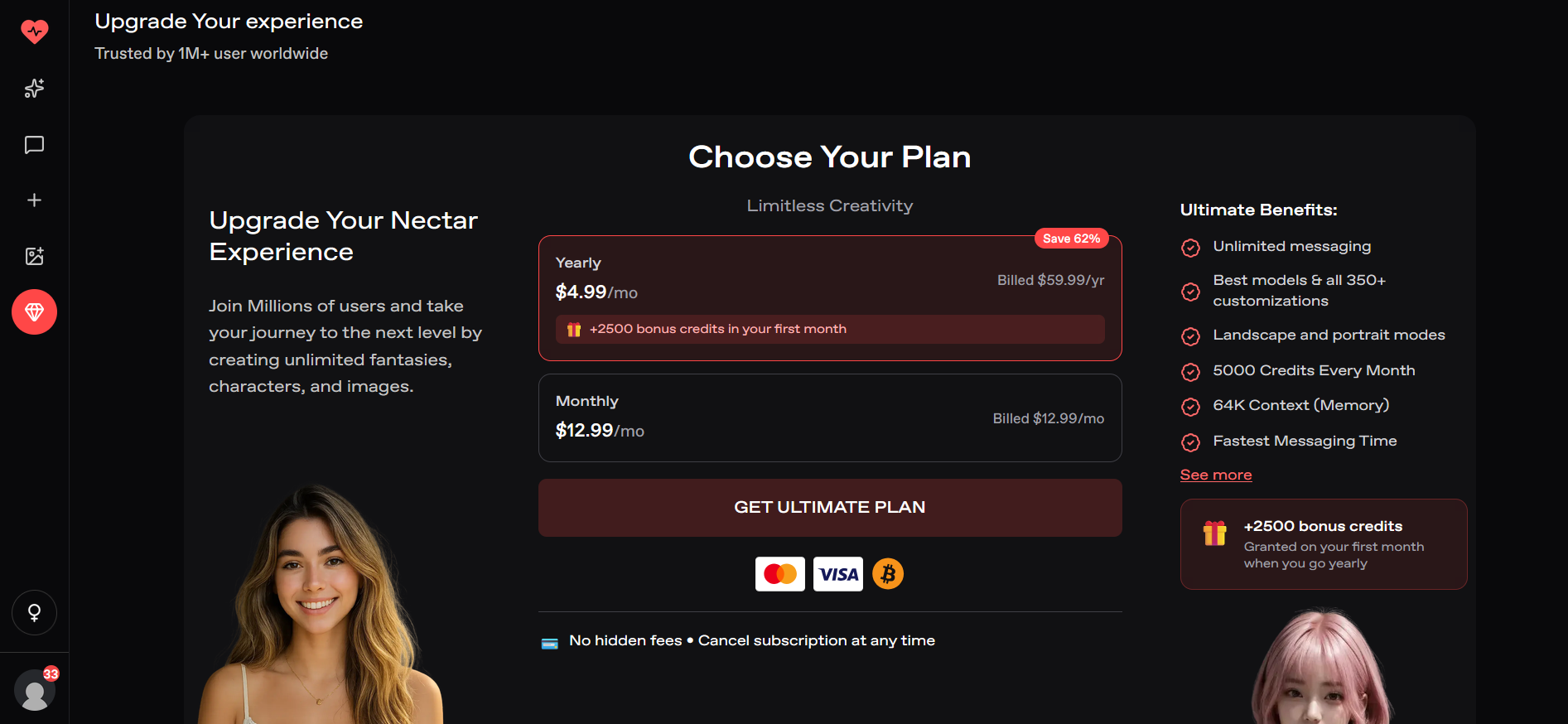
Nectar AI starts at around $9.99/month, with its annual Premium option bringing the effective price down to roughly $5/month when billed yearly. Its higher Pro tier is around $19.99/month, or about $10/month on the annual plan. The higher tiers give you more room for image generation, messages, customization, and other roleplay features.

Candy AI currently lists its monthly plan at $13.99/month. The 3-month option works out to $8.99/month, while the annual plan drops the effective price to $3.99/month, billed at $47.88 for the year.

The catch with Candy AI is the token system. Its subscription includes a monthly token allowance, but image generation, video, and some voice features use those tokens. That means the annual plan looks extremely cheap if you’re mainly chatting, but frequent media generation can push your monthly spending higher.

For Nectar AI vs Candy AI for roleplay, Nectar AI can therefore make more sense if your priority is building detailed characters and spending most of your time in conversations and scenarios. Candy AI is more attractive if you want a lower annual headline price and put more emphasis on polished visual content.

Bottom line: Candy AI has the cheaper annual subscription on paper, while Nectar AI offers a more useful range of plans for users who want deeper customization and roleplay. If you’re primarily a text-based roleplayer, Nectar AI’s pricing is easier to justify; if images and visual features are a big part of your experience, Candy AI can still be worth the money—but keep the extra token costs in mind.

Nectar AI vs Candy AI for Roleplay

Can I try both without spending much?

Yeah, both have free options but they’re pretty locked down. Nectar lets you poke around a bit and get a feel for the chat style. Candy’s free tier is more limited once you start requesting images or longer messages. If you just want to test the conversation vibe for a day or two, you can get away with the free versions. Once you want proper memory or any media, you’ll hit the paywall pretty quick on both.

Do either of them have a proper mobile app?

Candy works better on phones in my experience because of the PWA setup — it feels closer to a real app. Nectar is mostly web-only, so on a phone the layout can feel a bit cramped and less smooth. If most of your roleplay happens on mobile, that difference is noticeable.

How does the pricing actually feel after a few weeks?

Nectar is more straightforward — you pick a tier and that’s mostly it. Candy looks cheaper at first but the token system for images and videos can add up if you generate a lot of media. Some people end up spending more on Candy than the headline price suggests once they get into heavy visual roleplay. Depends how much you use the image/video features.

Is one clearly better for NSFW roleplay?

Both handle adult content without the heavy filters you get on more mainstream apps. The difference is more about style than restrictions. Candy feels more polished for visual NSFW scenes. Nectar keeps the character more consistent during longer, messier roleplay. Neither is perfect, but neither suddenly turns into a safety lecture mid-scene either.

How hard is it to create a custom character on each?

Candy walks you through it more and feels guided. You can get something looking and acting decent pretty fast. Nectar gives you more control if you’re willing to spend time shaping personality and details, but it takes a bit more effort up front. If you like tinkering, Nectar’s creation tools feel deeper. If you just want to jump in, Candy is quicker.

Do they remember stuff from previous days?

Both claim memory, but it works differently in practice. On longer roleplays that stretch across several days, one holds onto smaller details better while the other starts losing the thread sooner. Neither is perfect once conversations get really long. You’ll still have to gently remind them of things sometimes.

Can I use both at the same time without it feeling weird?

Plenty of people do. Some keep one for visual/image-heavy sessions and the other for longer text roleplay. There’s no technical problem with running both. The only real issue is getting used to the different response styles and memory quirks so you don’t expect one to behave like the other.

Affiliate Disclosure: This article contains affiliate links, which means I may receive a small commission if you sign up through a link on this page. This comes at no extra cost to you and helps support the website. My reviews and recommendations are based on my own research and opinions.

About the Founder: Simon Norman

I built AI Companion Kit to be an independent AI companion hub focused on transparent research, practical insights, and honest evaluations of AI companion platforms. My goal is to help readers understand how these apps work, what makes them different, and which features actually matter before they make a decision.

To learn more about who is behind AI Companion Kit, my research process, and the editorial standards used across the site, visit About the Founder (Simon Norman).


About the Founder: Simon Norman