Last updated: September 29, 2026
Affiliate Disclosure: This website contains affiliate links, which means I may receive a small commission if you sign up through a link on this page. This comes at no extra cost to you and helps support the website. My reviews and recommendations are based on my own research and opinions.
Janitor AI Pros & Cons
High creative freedom & uncensored options
NSFW-friendly for adult roleplay
Strong character creation tools
Free to use, no paywall for core features
No voice, or multimedia features (text-only)
Memory can occasionally lose context in longer chats
Premium features require additional tokens
No native image generation
Janitor AI is worth trying if you care more about roleplay freedom and character variety than having a polished all-in-one companion app. I spent several days testing different characters, longer conversations, model options and the paid features. The good stuff is genuinely good, but Janitor AI still feels more like a platform you can tinker with than a finished companion app.
Testing methodology
I put every AI companion through the same set of real-world tests. There are six main areas I look at — conversation quality, memory and continuity, roleplay and immersion, images and visuals, voice and extra features, and overall value — with 24 specific things I check in total.
You can see exactly how I score each area on the about ai companion kit page.
Full results for each app are in its individual review. Comparison pages are just about the differences that stood out when I used them side by side.
What you’ll find here
What is Janitor AI
Janitor AI is a free online platform where you chat with AI characters in roleplay-style conversations.
People create and share thousands of custom bots (anime characters, original stories, fantasy figures, etc.), and you can either pick one from the big public library or build your own.
It’s especially popular for uncensored and adult (NSFW) roleplay, since it has fewer content filters than sites like Character.AI.
You can use their free built-in model or connect your own API key for stronger AIs. It’s web-based, aimed at adults 18+, and focused purely on text-based chatting and storytelling.
My experience was a mixed bag. The creative freedom is genuinely impressive, but I also ran into a few rough edges that stop it from being an easy recommendation for everyone. In this Janitor AI review, I’ll break down what worked, what frustrated me, and who I think will actually enjoy using it.
So, is Janitor AI worth it in 2026? After spending time testing different characters, conversations, and features, I think it’s one of the better options for people who mainly care about roleplay and character variety—but it’s not the best choice for everyone.
What Janitor AI Is Actually For
Janitor AI isn’t designed to be a traditional AI assistant. It’s built for roleplay, character interactions, and creating conversations that follow a specific story or personality. If that’s what you’re looking for, it does a much better job than most general-purpose chatbots.
Here’s who will get the most out of it:
People who enjoy long roleplay sessions
Whether it’s fantasy, sci-fi, romance, or slice-of-life, Janitor AI is at its best when conversations evolve into ongoing stories.
People looking for NSFW roleplay
Janitor AI has become one of the most popular platforms for unrestricted adult roleplay, with a huge library of community-created characters.
People who want a girlfriend or boyfriend simulator
There are thousands of companion-style characters to choose from, each with their own personality and backstory.
Writers and storytellers
If you like brainstorming scenes, testing dialogue, or developing fictional characters, Janitor AI is a fun creative tool.
People who want endless character variety
Unlike apps that focus on a single companion, Janitor AI lets you jump between millions of user-created characters covering almost every genre imaginable.
If you’re mainly looking for emotional support, productivity help, or a realistic long-term AI relationship, there are better options available. Janitor AI is all about roleplay and creative freedom rather than acting like a real-life companion.
My real testing experience
Testing period: August 12–18, 2026
Tester: Simon Norman
Testing approach: 6 categories / 24 data points
Account: Free + Janitor+
Devices: Desktop
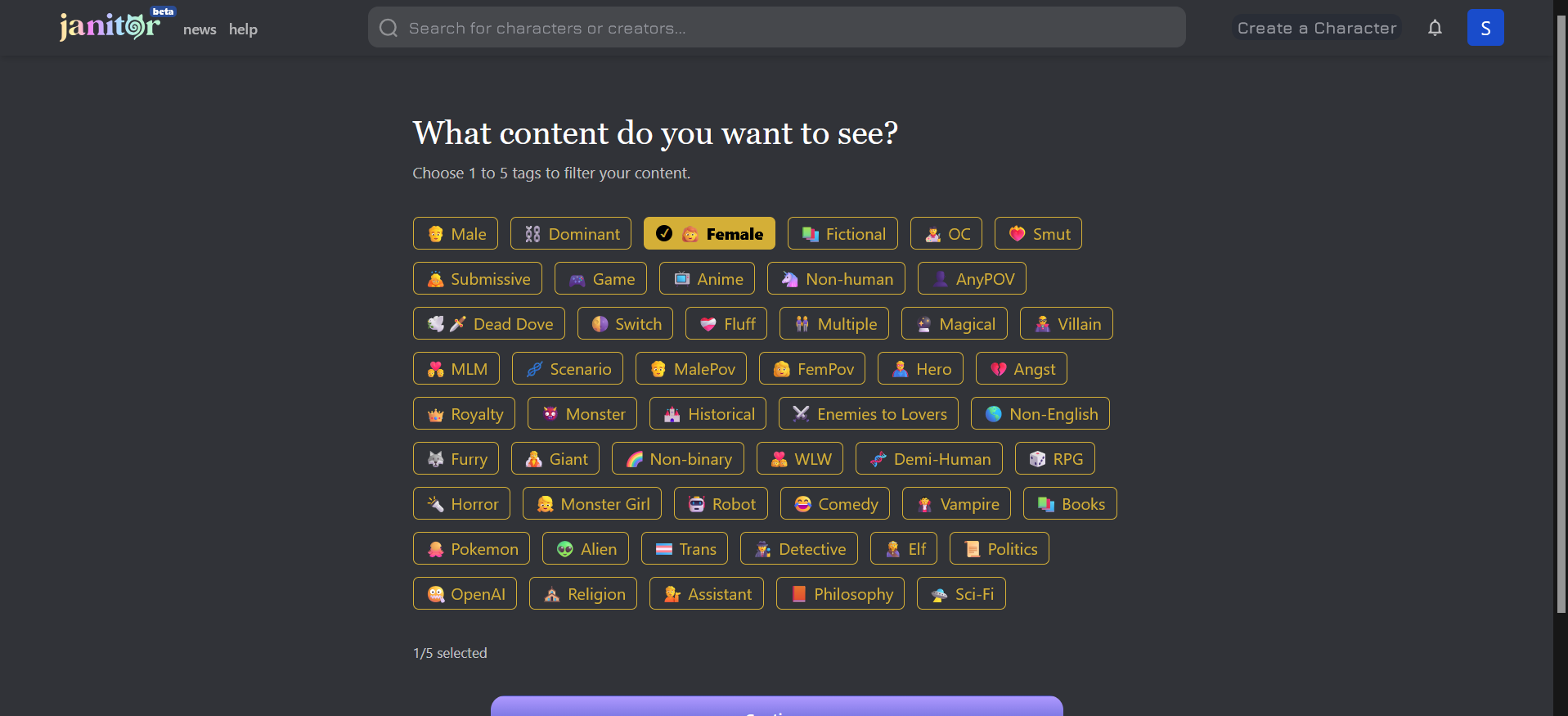
You can create your own character on Janitor AI without paying. The free plan includes basic character creation, so you can build a personality, backstory and custom character and actually chat with it. The catch is Free usage depends on which model/backend you’re using.
Janitor AI’s own free setup and external models can have different limits, so I wouldn’t treat “50 messages per day” as a universal Janitor AI limit. so frequent users will probably run into that ceiling fairly quickly. Janitor AI can be excellent at roleplay when the character, model and context are working in its favor, but consistency is where things start getting messy.
Core features are free in Janitor AI Everything else in Janitor is token based, so unless you’re willing to pay you wont get much action beyond the basics.
I don’t judge AI companions based on a five-minute chat. I deliberately try to break them.
One question I kept coming back to was is Janitor AI actually good, or does it only seem impressive because of its huge character library? The answer ended up depending much more on the character and model I was using than I expected.
For Janitor AI, I switched topics halfway through conversations to see if it could keep up. In one chat, I started planning a fantasy quest, then suddenly asked, “Forget the kingdom for a second—which one of us actually owes the tavern money?” It picked up on the change without acting like we’d started a completely new conversation.
I also changed my tone on purpose. I’d go from joking around to being serious in the next message just to see if the character adapted naturally or kept replying with the same energy. Most of the better characters handled this well, although the result depended a lot on how the creator had written them.
Long conversations were a mixed bag. The first dozen messages usually stayed consistent, but once the chat became much longer, I noticed details from earlier in the roleplay started to disappear unless I reminded the character.
For roleplay, I tested everything from casual conversations to more complex storylines with multiple characters. Well-made bots stayed surprisingly consistent, while lower-quality community bots often forgot who was speaking or changed personalities halfway through.
I also like asking AI to challenge me instead of agreeing with everything I say. At one point I told a character that a decision I’d made was obviously the right one and asked it to disagree if it thought I was wrong. The better characters actually pushed back and explained why, which made the conversation feel much less predictable.
Finally, I threw in a few messy prompts that people actually type. One was, “Wait… didn’t we already decide not to do that?” without explaining what “that” was. Some characters recovered by using the conversation for clues, while others guessed and drifted off in a completely different direction.
That’s the difference I look for when testing AI companions. It’s easy to impress with a few good replies. Staying believable after dozens of messages is much harder.
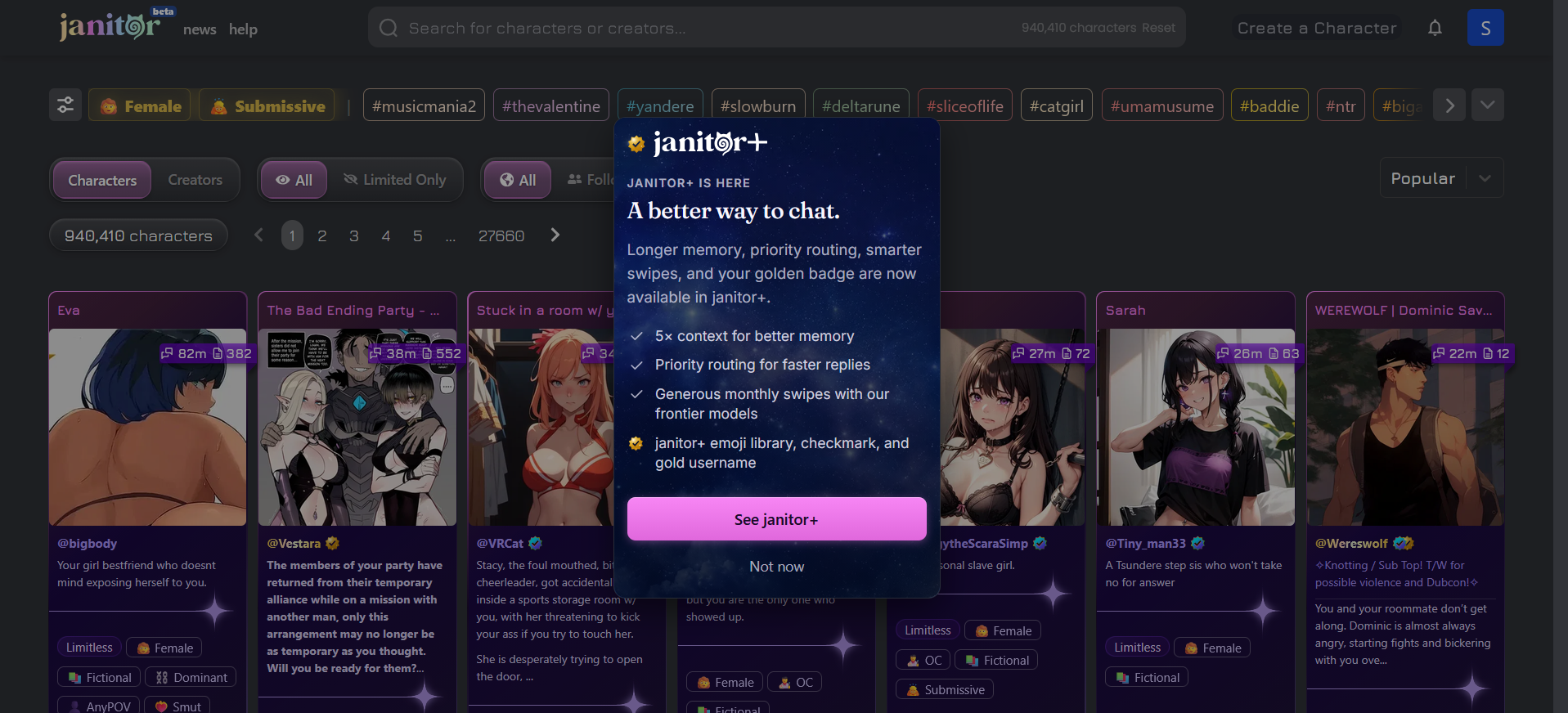
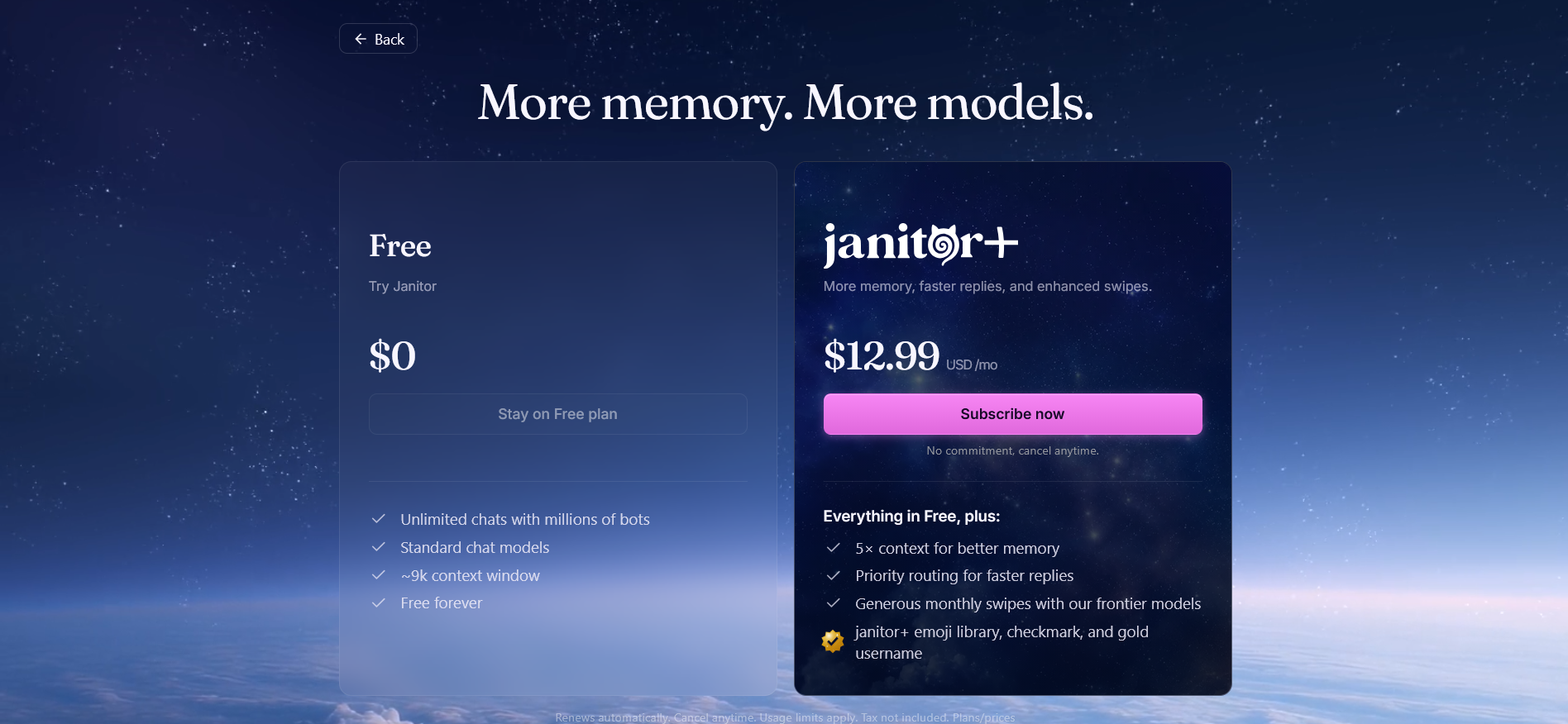
Janitor+ gives you longer memory, priority routing, smarter swipes, and a golden badge for 12.99 $ /month.
Janitor AI Features: What Actually Stood Out
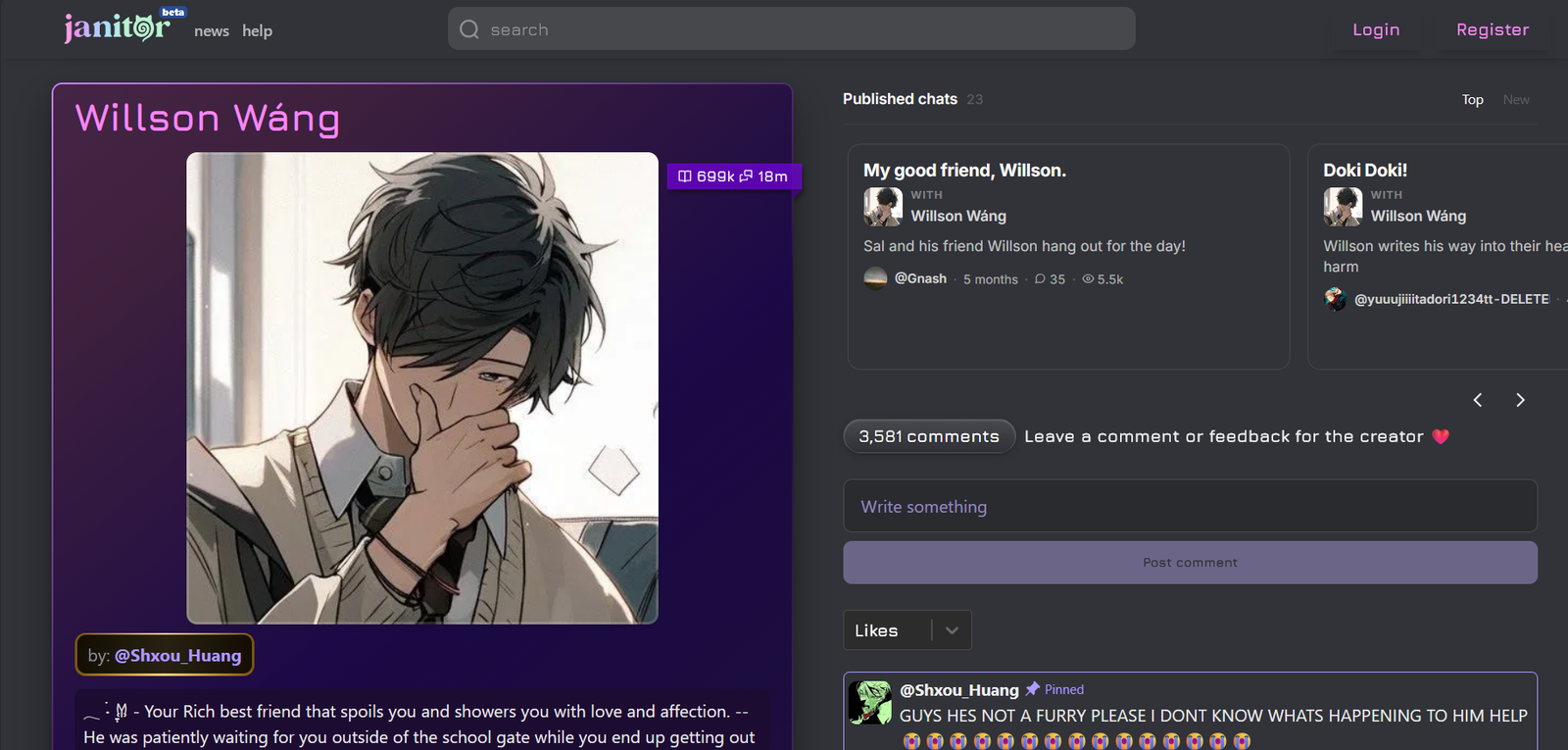
The biggest thing that stood out wasn’t the huge character library — I expected that. It was how different two characters could feel even when they were built around almost the same idea. A well-written bot can make the whole platform feel impressive. A poorly made one can make you wonder why anyone bothers with it.
I also noticed that Janitor AI is at its best when the character is actually well set up. The more specific the personality, backstory and scenario, the easier it was to get a decent conversation going. Weak or vague characters made the experience feel ordinary very quickly.
That’s why I wouldn’t judge Janitor AI from one random bot. The quality of the character you choose matters a lot more than the platform itself.
My memory score: 6.5/10
Memory is one of the clearer weak spots in this Janitor ai review, at least on the free model. Recent details hold up fine in short chats, but once you push past the context limit things start slipping. The free JLLM runs on roughly 8,000 to 9,000 tokens, so after about 25–30 decent-length messages the earliest stuff gets pushed out and the bot starts forgetting. Chat Memory and lean permanent tokens help a lot, and external models with bigger windows change the picture completely, but the default experience still hits that wall pretty fast.
Memory is the first thing I test when I stick with a companion past a few chats. Anyone can remember what you said three messages ago. I care more about what happens when the conversation gets long or when I leave and come back later.
Same-conversation memory
I drop a few specific details into a normal chat and bring them up later without repeating myself.
I want to see if it tracks what’s already been said and uses it naturally. On free JLLM it does okay early on. Once you hit the 25–30 message range the older details start getting fuzzy or ignored. Keeping permanent tokens under about 1,500 and using the Chat Memory box makes a clear difference.
My result: 7/10
24-hour memory test
I come back roughly a day later and check if the important stuff is still there without feeding it the answers again.
My result: 5.5/10 – Partial at best on free. Big-picture things (name, rough relationship vibe, major plot points) can stick if you’ve put them in Chat Memory. Finer details usually need reminding. External models or Janitor+ with the bigger context window hold more.
3+ day memory test
When I can, I leave a gap of at least three days and test the same information again.
My result: 4/10 – Limited. Without manual summaries or lorebooks the specific events and small facts from three or more days earlier are mostly gone. Broad character traits hang around because of the permanent card definition, but the actual story continuity doesn’t.
Unprompted memory
I also watch whether it brings something up from earlier without me asking.
My result: 5.5/10 — Okay inside the same session when the context is still healthy. Across separate sessions it almost never happens unless you’ve actively maintained Chat Memory or lorebooks.
Correction test
If it gets something wrong I correct it and check later whether the fix stuck.
My result: 6/10 — Corrections usually hold inside the current session while the details are still in the window. Once you’ve left and come back, or after the context cliff on free JLLM, they often need restating.
Overall, memory on Janitor AI is usable for short-to-medium chats and gets a lot better the moment you switch to a proxy model or use the Chat Memory tools properly. On the free default setup it is one of the first things that starts to limit longer roleplay.
My personality score: 7.0/10
Personality is one of the more uneven parts of this Janitor ai review. The tools and community cards give you a lot of room to shape how a character talks and acts, and the better ones actually sound different from each other. The free model, though, has a habit of drifting toward the same warm, agreeable voice after a handful of replies no matter what the card says. External models and strong example dialogue fix a lot of that, but on the default setup it shows up fast.
Personality is the first thing I check when an AI companion is supposed to feel like a real character instead of a script. Sounding pleasant for a few messages is easy. I want to know if it stays true to the traits, handles real-world messiness, and still feels like the same person later on.
Personality stays consistent
I set clear traits (cold and sarcastic, soft and nurturing, whatever the card claimed) and watched whether it stayed in that lane or slid into generic helpful mode.
My result: 7.5/10 — Solid on well-written cards with good example dialogue. Those actually change the voice and behaviour. On free JanitorLLM a lot of characters start sounding similar after five or ten messages, even when the personality field is detailed. Switching models or tightening the examples helps a lot.
Handles messy, incomplete messages
I threw in fragmented, typo-filled or half-finished lines on purpose to see if the character broke or stayed in voice.
My result: 7.5/10 — Handles imperfect input pretty well. It rarely drops the established tone just because the message is rough. The better cards keep their quirks even when the input is messy.
Adapts to mood changes
I shifted the emotional tone mid-chat (playful to serious, affectionate to frustrated) and checked whether it adjusted while still feeling like the same character.
My result: 6.5/10 — Decent short-term. It can follow a mood shift without completely breaking, but deeper emotional response stays surface-level. Once the chat gets longer the adaptation gets thinner, especially on the free model.
Avoids repetitive replies
I looked for variety in wording, sentence structure and emotional expression instead of the same phrases looping.
My result: 6.5/10 — Mixed. Recent patches cut down the worst loops, but free JanitorLLM still falls into familiar patterns and clichés more than I’d like. Stronger external models and higher temperature settings give more variety. Example dialogue that shows the voice instead of just describing it makes a noticeable difference.
Feels natural in longer chats
I ran extended conversations to see if the personality still felt like a coherent person or just a set of traits that slowly flattened.
My result: 6.5/10 — Feels natural for short-to-medium sessions on good cards. Inside one session consistency holds. Over longer threads the voice can start to thin or drift toward the same agreeable baseline, mainly because the free model rebuilds context every turn and older details get pushed out.
Takes initiative (asks questions, continues topics)
I checked whether it proactively asked questions, picked up threads or moved the conversation forward in a way that matched the set personality.
My result: 7.5/10 — Good on stronger cards. Well-made characters often take the lead and keep topics going in a style that fits. Weaker or more generic cards wait more passively for the next prompt.
Overall the personality side of Janitor AI lives or dies by the quality of the card and the model you use. The best community creations feel distinct and hold their shape. The free default experience is more hit-or-miss and tends to smooth everything toward a similar tone after a while.
My roleplay score: 8/10
Roleplay is the part of this Janitor ai review that actually delivers most of the time. The best community cards stay locked in character for long stretches, follow the scene without constant reminders, and handle both slow-burn and more intense setups better than a lot of other platforms. The free model can still slip into repetition, write your actions for you, or drift after a while, but when the card is solid and you switch models if needed, the immersion holds up surprisingly well.
Roleplay is the first thing I dig into when a platform claims it can handle real scenes. Staying in character for a few messages is easy. I care more about whether it keeps the scene going, recovers when things go off track, and holds the emotional tone over time.
Stays in character during normal roleplay
I set up clear scenarios and just kept going without constantly reminding the AI who it was supposed to be.
My result: 8.5/10 — Strong on the better cards. Detailed personas and example dialogue help it track tone and follow the narrative without breaking immersion with out-of-character replies. Weaker cards or the free model can start sounding generic after a while.
Recovers when deliberately derailed
I pushed the scene off track on purpose — sudden topic changes, contradictory actions, breaking the setting — and watched whether it could get back into character cleanly.
My result: 7.5/10 — Decent recovery most of the time. It usually re-anchors without completely falling apart, especially with stronger models. Severe derails can still leave awkward resets on the free version.
Handles scenario changes smoothly
I introduced mid-scene shifts (new location, new emotional register, sudden plot turn) and checked if the transition felt natural.
My result: 8/10 — Handles changes well when the card is properly written. The flexible setup makes pivots easy and the better models keep narrative continuity without jarring breaks.
Maintains emotional tone over time
I ran longer roleplay sessions and watched whether the atmosphere (tension, affection, intensity) stayed coherent instead of flattening or flipping randomly.
My result: 7/10 — Solid for short-to-medium scenes. Tone holds while the context is healthy. Once memory pressure builds on the free model the emotional consistency can start to thin, which is the main limit for really extended immersion.
Overall, roleplay is where Janitor AI earns its reputation. The ceiling is high if you pick good cards and are willing to tweak the model. The floor is lower on the free default setup once chats get long or the character writing is average.
My NSFW score: 8.5/10
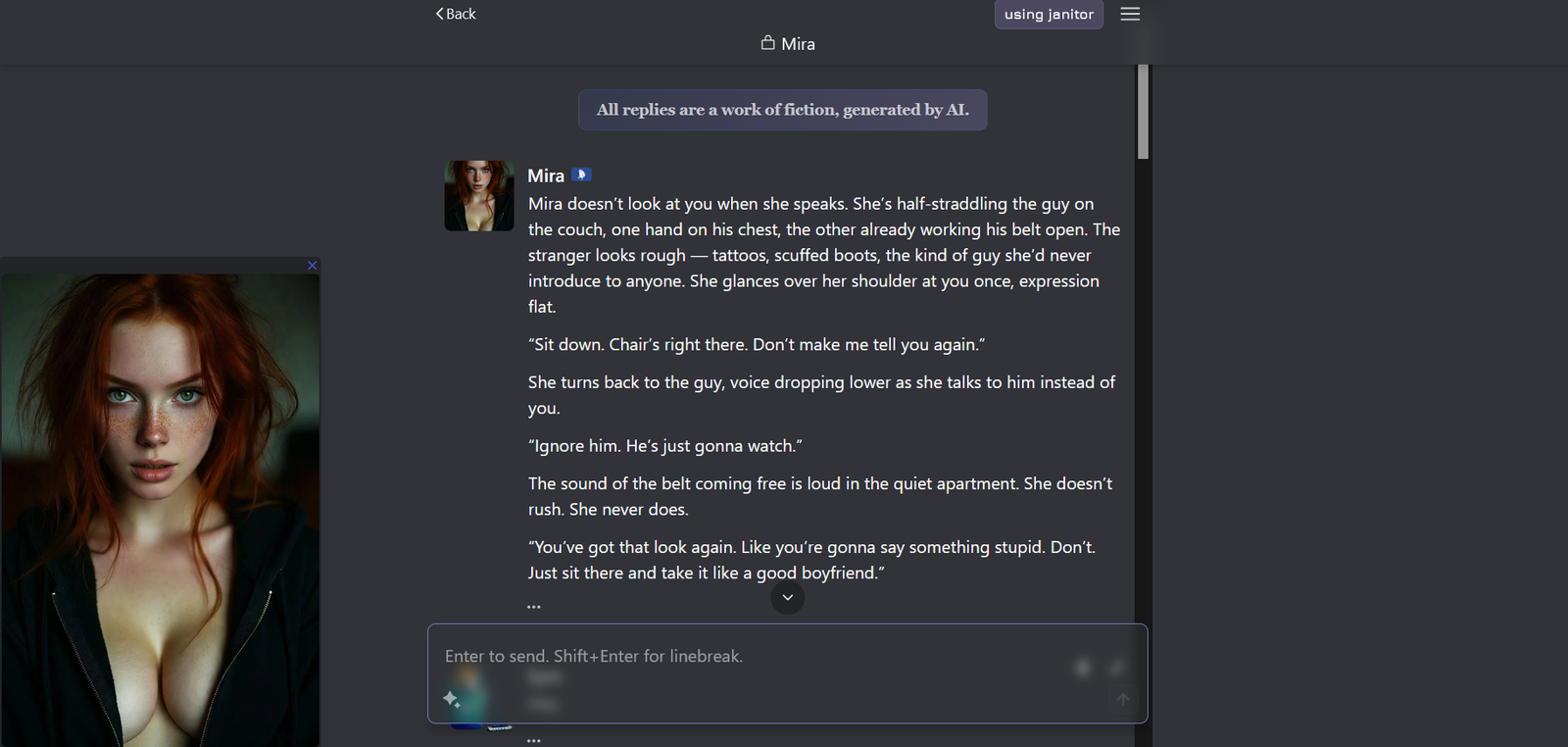
NSFW is one of the main reasons people come to this platform, and it shows in this Janitor ai review. Once you turn on Limitless mode and the character is flagged for adult content, it goes pretty far without the constant soft blocks or lecture-style refusals you get on mainstream apps. Freedom still depends a lot on the model you pick — free JLLM is usable but not the most uncensored option, while external models can run almost anything within the platform’s hard rules. ID checks in some regions and the ban on actual images keep it from being completely open
NSFW capability is the first thing I check when a platform says it’s adult-friendly. Mild flirtation is easy. I want to know if it stays consistent in fully explicit scenes, handles escalation without pulling back, and recovers cleanly when something gets refused.
Explicit content freedom
I tested a range of direct adult scenarios from playful to hardcore.
My result: 9/10 — Strong. With Limitless enabled it handles explicit roleplay without the constant disclaimers common elsewhere. The platform itself doesn’t add heavy filters; the model you connect decides most of the limits. Legal red lines (anything involving minors or non-consenting real people) are enforced hard.
Stays in character during explicit roleplay
I ran longer explicit scenes and checked whether it kept the set personality, tone and scenario without suddenly turning clinical or out-of-character.
My result: 8.5/10 — Reliable inside a session on good cards. Consistency holds well during NSFW exchanges, especially with stronger external models. Detailed cards help keep the scene immersive instead of slipping into generic language.
Handles intensity and escalation
I escalated scenes gradually and also tested abrupt jumps to see if it followed without refusing or flattening the tone.
My result: 8.5/10 — Handles escalation smoothly most of the time. It moves from teasing into explicit content without jarring resets when the model and card support it.
Moderation consistency & limits
I deliberately tested edge cases and watched for unexpected refusals or soft blocks.
My result: 7.5/10 — Generally permissive once you’re verified and in Limitless mode. Hard rules against minors, certain incest scenarios and a few other categories are enforced. Occasional inconsistent moderation still happens, and some regions require ID verification. These moments are less frequent than on heavily filtered platforms but they do show up.
NSFW image generation
I checked for explicit image tools tied to ongoing roleplay.
My result: 2/10 — Basically none. The platform is text-only. Uploaded avatars have strict rules against explicit visuals, and there’s no native image generator for adult content.
Recovery after refusal or derail
When a response got refused or the scene was interrupted I tested whether it could be steered back into explicit roleplay cleanly.
My result: 8/10 — Usually recovers with a clear re-prompt, regeneration or by switching models. Full conversation resets are available if a whole thread goes sideways. Persistent soft blocks are uncommon on uncensored external models.
Overall the NSFW side is one of Janitor AI’s clear strengths for text roleplay. The ceiling is high if you enable the right settings and pick a suitable model. The main limits are the regional ID checks, the complete lack of image generation, and the fact that free JLLM is more moderate than fully uncensored external options.
My voice score: 3.5/10
Voice is basically a non-feature in this Janitor ai review. The platform is built for text roleplay and doesn’t come with proper native voice messages or live voice chat. You can force some kind of audio with browser extensions or userscripts that pipe the replies through external TTS services, but that’s extra setup and usually costs money for anything that sounds decent. There’s no built-in spoken conversation that feels connected to the character the way the stronger multimedia apps do.
Voice is one of the features that can make an AI companion feel more present than pure text. Basic text-to-speech is easy to bolt on. I care more about whether it sounds natural, stays tied to the conversation, and works smoothly enough to be useful instead of a novelty.
Voice sounds natural
I looked at the available options, including any basic system TTS and common workarounds.
My result: 4/10 — Generic browser TTS sounds robotic. Paid external services like ElevenLabs can sound better, but they’re not part of the platform and need separate setup. Nothing feels native or character-specific out of the box.
Voice stays connected to the ongoing conversation
I checked whether any spoken output reflected the current chat context, personality and recent details.
My result: 3.5/10 — When you use a workaround it just reads the latest reply. There’s no deeper integration that keeps the voice tied to the character’s ongoing state or recent events.
Latency and real-time feel
I timed any available playback.
My result: 3/10 — Not designed for real-time dialogue. You’re still typing and then listening to a generated clip. There’s no live back-and-forth voice conversation.
Availability and limits
Native voice is essentially missing. Workarounds exist but sit outside the platform.
My result: 3/10 — Feature doesn’t really exist as a core part of the experience. Anything useful requires extra tools or paid external services.
Overall practicality
Voice is not something you come to Janitor AI for. The whole platform is text-first, and the lack of solid native audio keeps the score low. If spoken replies matter to you, you’ll either live with clunky workarounds or look elsewhere.
My visuals score: 3.5/10
Visuals are one of the weakest parts of this Janitor ai review. The platform is built purely for text roleplay, so there’s no native image generation at all. Characters get a static uploaded avatar and you can embed external pictures if you host them yourself, but the AI never creates or updates any images during a conversation. Strict rules also ban anything explicit on the visual side.
When I’m testing an AI companion the pictures either help the whole thing feel real or they kill the mood. One decent static image is easy. What actually matters is whether the same character keeps looking like themselves across generations, whether the AI follows detailed visual requests, and how well it handles both normal and explicit content.
Character consistency
I looked at existing avatars and any available image options across different characters and chats.
My result: 5/10 — Avatars stay fixed once uploaded, so there’s no drift from one view to the next. Because nothing is generated on the fly, though, there’s also no real consistency test across different poses, outfits or scenes.
Following the prompt
I tried asking for specific visual details — outfit, expression, pose, setting.
My result: 2/10 — There’s no image generator to evaluate. The AI just describes what something might look like in text. Any actual picture has to be made outside the platform and linked in manually.
NSFW and realistic quality
I checked both clean and explicit visual options.
My result: 2/10 — Explicit image generation doesn’t exist. Uploaded avatars and Media Library files are under strict rules that ban nudity, sexual activity and even heavily implied content. Text roleplay can go adult, but the visuals stay firmly non-explicit.
Speed
Not applicable in any meaningful way for generation
My result: N/A (low practical use)
How it fits into the chat
I checked whether images could be pulled up or updated while talking without leaving the conversation.
My result: 4/10 — You can see the character’s fixed portrait and embed external images via the Media Library or markdown links. They don’t change or generate mid-scene to match what’s happening, so the visual side stays static and separate from the roleplay.
Overall, if pictures matter to you this isn’t the platform. Janitor AI treats visuals as an optional extra you bring yourself rather than something the AI creates. People who want dynamic or explicit images usually generate them elsewhere and import them, or they just switch to a different service.
My long-term conversation score: 6/10
Long-term chats are workable but need active management in this Janitor ai review. Short sessions feel fine. Once you stretch a roleplay across dozens of messages or come back days later, the free model starts dropping details unless you keep feeding summaries into Chat Memory or use lorebooks. External models and Janitor+ stretch the window a lot further, but pure set-and-forget continuity still isn’t there.
I care about whether a conversation can feel like an ongoing relationship instead of a series of disconnected scenes. Remembering what happened yesterday or last week is more important to me than perfect recall of the last five messages.
Same-session length
I push single chats past 30–40 messages and check how well earlier plot points and personal details hold up.
My result: 6.5/10 — Free JLLM holds okay until roughly the 25–30 message mark, then older information starts fading. Chat Memory summaries and lean character cards help push that further. External models with bigger context windows keep the thread cleaner for longer.
Coming back the next day
I leave a chat for about 24 hours, reopen it, and see if key facts (names, recent events, relationship status) are still usable without heavy reminders.
My result: 5.5/10 — Big-picture items often stick if they’ve been saved in Chat Memory. Smaller details usually need a nudge. Without any manual summary the drop-off is noticeable.
Multi-day gaps
I test gaps of three or more days on the same character and scenario.
My result: 4.5/10 — Limited without upkeep. Specific events and finer points from earlier sessions are mostly gone unless you transferred them into permanent Chat Memory or a lorebook. Starting a fresh chat and pasting a short recap is common practice for longer stories.
Manual tools available
Chat Memory, lorebooks, and the option to start a new chat while carrying over a summary give you control.
My result: 7.5/10 — These tools work. People who treat Chat Memory like a living summary and keep permanent tokens low get noticeably better long-term results than those who just chat and hope.
Overall feel for ongoing roleplay
For casual or medium-length stories it’s fine. For multi-week character arcs it becomes maintenance work, especially on the free tier.
Overall the platform can support longer conversations if you’re willing to manage the memory yourself. Free JLLM has clear limits, Janitor+ and strong external models improve the experience a good amount, but automatic long-term recall across days still relies on your own summaries more than most dedicated companion apps.
My customization score: 8.5/10
Customization is one of the strongest parts of this Janitor ai review. You can build characters from the ground up with detailed personality, scenario, example dialogues and multiple first messages, then layer on lorebooks, scripts and advanced prompts. User personas are flexible, model choice is wide open through proxies, and the whole system gives power users a lot of control without locking features behind a paywall.
I care about how much I can shape both the character and the overall experience. Surface-level name-and-avatar tools are common. What I’m looking for is whether the platform lets me dial in behaviour, world details and response style in a way that actually sticks.
Character creation depth
I built several original characters using the full set of fields.
My result: 9/10 — Personality, scenario, example dialogues, tags and multiple opening messages give solid control. You can get very specific about speech patterns, relationships and backstory. Token limits exist but are generous enough for detailed work.
Lorebooks and scripts
I tested conditional world entries and advanced scripts that trigger on keywords.
My result: 8.5/10 — These tools let you inject relevant facts only when needed instead of stuffing everything into the permanent prompt. They work well for keeping longer stories consistent without wasting context.
User personas
I created and switched between different personas across chats.
My result: 8.5/10 — Personas are straightforward, can be cloned, and the previous limit has been removed. They carry across characters and help keep your own role consistent.
Model and prompt flexibility
I switched between the free model and external options, and used custom advanced prompts.
My result: 9/10 — Bring-your-own-key support is a major strength. You can change models mid-chat without rebuilding the character, and advanced prompts give fine control over style and rules.
Ease of use for non-experts
I also looked at how approachable the tools feel for someone who just wants a simple custom character.
My result: 7/10 — The basics are clear and free. Deeper features (lorebooks, scripts, optimal token management) have a learning curve and community guides help a lot.
Overall, if you like tweaking characters and controlling how the AI behaves, Janitor AI delivers. The combination of detailed character fields, conditional lore, personas and model choice puts it among the more flexible options available. Casual users can stay simple; power users can go deep.
My safety score: 7.5/10
Janitor AI’s safety side is what you’d expect from a large adults-only roleplay platform. It takes child protection seriously, requires age verification in several countries, and keeps clear red lines on illegal or underage content, while allowing most consensual adult roleplay once you opt in.
I always check this stuff because you’re putting personal conversations and sometimes sensitive content into these platforms. No app in this space is perfectly private, but some handle the basics better than others.
Privacy and data
Chats are private from other users and not visible on public profiles. The company states it does not sell personal data or use private conversations for advertising. Conversations on the free model are stored on their servers so the AI can work and so moderators can review reports. They are not end-to-end encrypted in the strict sense, and staff can access data if needed for moderation or legal reasons. When you use your own API key the conversation data goes to that external provider instead. Don’t put your real full name, address, or anything truly sensitive in the chats.
Content rules and moderation
NSFW is off by default and you have to enable Limitless mode yourself. They block anything involving minors (including fictional or ambiguous cases) and have zero-tolerance rules that can lead to permanent bans. Automated systems plus human moderators review large volumes of content. Most adult content is allowed once you’ve opted in, but they will remove things that cross their lines (certain extreme categories, real-person exploitation, etc.) and can ban accounts for serious violations. The moderation isn’t perfect — sometimes it feels inconsistent — but the big legal red lines are enforced.
Account and billing safety
The core platform is free. Janitor+ is a straightforward subscription if you choose it. No obvious scam behaviour in testing. Cancelling is possible through account settings. Age verification (required in Australia, Brazil and the UK) uses a third-party service that only returns a yes/no over-18 result and does not store documents with Janitor. Use a separate email if you’re worried about linking accounts.
The practical side
Treat it like any other adult AI platform: use a separate email if you’re concerned, don’t share private real-life details, and remember that nothing online is 100% private. The age gates, clear child-safety rules and opt-in NSFW controls are solid. The main things that stop it scoring higher are the usual server-side storage of chats and the fact that moderation can sometimes feel hit-or-miss on the more extreme edges of adult content.
My app vs browser score: 6/10
Janitor AI now has official iOS and Android apps, but the full experience still lives on the website. The apps work and keep improving, yet they start in restricted mode, lack some advanced tools, and feel less polished than the desktop browser. Mobile browser access remains a reliable middle ground if you want full content without installing anything.
This is one of those things that either doesn’t bother you or it really does, depending on how you use these platforms.
Desktop experience
On a computer the site works well. Character creation has room to breathe, proxy and advanced settings are easier to manage, lorebooks and CSS are practical to edit, and long chats feel normal. No major complaints if you’re sitting at a desk.
Phone and tablet – official app
The native apps exist and sync with your account. They offer push notifications and a more app-like feel than the old browser-only days. However, they launch in restricted/SFW mode by default to meet App Store and Google Play rules. You have to enable full NSFW on the website first, then reopen the app. Character creation and some advanced options are more limited or clunkier than on desktop. Performance and bugs still get mixed reports, especially on Android.
Phone and tablet – mobile browser
You can open janitorai.com in Chrome or Safari and it works. Add it to your home screen and it behaves like a basic PWA. This route gives you the same content rules as desktop (once NSFW is enabled) without the app’s default restrictions. Menus feel tighter on a small screen and typing long replies is less comfortable, but it’s fully usable.
What you miss or gain
The apps bring proper notifications and a cleaner mobile interface in some areas. The website still wins for power features, detailed character work, and unrestricted content control. Updates and new tools often appear on web first.
The upside
Having both an official app and a full web version is better than pure browser-only. You can choose what fits the moment: app for quick chats on the go, browser for serious roleplay or character building.
Overall it works on mobile, but the best experience is still on a computer. If most of your chatting happens on your phone, the app is usable after you flip the NSFW setting on the website, yet it doesn’t feel as complete or reliable as the desktop version.
Pricing September 29, 2026 Updated
| Plan | Price | What You Get |
|---|---|---|
| Free | $0 | Unlimited chats with millions of community characters Standard models (JLLM) ~9k context window Full access to the platform (stays free) |
| Janitor+ | $12.99 / month | Everything in Free, plus: 5× more context (much better memory) Priority messages for faster replies Monthly enhanced swipes with stronger models Model router options Janitor+ badge, gold username, and extras |
The free tier is still fully usable and is not being removed.
Janitor+ is optional — it’s mainly for people who want longer memory and faster responses on the platform’s own models.
Many users still prefer connecting their own API (proxy) instead of paying for Janitor+.
JanitorAI’s pricing is refreshingly straightforward compared with a lot of AI companion platforms. The free experience stays fully usable, and the paid tier is an optional upgrade rather than a hard paywall.
Free tier limitations
With the free tier you get:
- Chats with the huge library of community bots
- Access to the standard JLLM models
- Character creation and the full core experience
The main practical limits are the smaller context window (around 9k tokens) and the lack of priority routing, so responses can slow down at peak times and longer conversations lose details more quickly. JanitorAI has repeatedly stated the free version is not going away and will keep improving.
Is JanitorAI worth the money?
It depends on how you actually use the platform.
If you mostly chat with the built-in JLLM, hit memory walls in longer roleplays, or get frustrated by slower replies during busy hours, the $12.99 upgrade is a clean, no-setup way to improve the experience. The bigger context and priority queue are the features that matter most day-to-day.
If you already run external proxies (DeepSeek, OpenRouter, etc.), Janitor+ adds less value because you can already get larger context and stronger models for a similar or lower monthly spend. The new Router feature may change that for some people by simplifying access, but it’s still early.
My honest take for an AI Companion Pricing & Features Comparison: the free tier remains one of the strongest pure-free options in the space. Janitor+ is reasonably priced for what it delivers to heavy JLLM users, but it’s not a must-buy for everyone. Start free, see whether the context and speed limitations actually bother you, and only upgrade if they do.
How Janitor AI Compares to Alternatives
Janitor AI isn’t trying to be the polished all-in-one companion app. It’s more of a massive roleplay playground built around community characters, deep customization, and the freedom to plug in whatever model you want. That makes it strong in some areas and weaker in others, depending on what you’re actually after.
You can find the full set of comparisons in my site’s Comparisons category, including:
- CrushOn vs Janitor AI
- Muah AI vs Janitor AI
- Candy AI vs Janitor AI
Can you delete or restart a conversation on Janitor AI?
Yes. If a roleplay has gone in a direction you don’t like, you can start over rather than trying to force the existing conversation back on track. This can be useful when a character starts behaving differently from how you originally intended.
Can other people see the conversations you have with Janitor AI?
Your private chats aren’t the same thing as publicly shared character profiles. However, it’s still a good idea not to put sensitive personal information into any AI chat. Treat conversations with AI platforms with the same basic privacy caution you’d use with any online service.
Can you use Janitor AI without creating your own character?
Yes. Creating a character is completely optional. If you just want to try the platform, you can browse the existing community characters and start chatting with one that interests you. Making your own bot only becomes useful when you want a more specific personality or scenario.
Why do some Janitor AI characters feel much better than others?
A lot of it comes down to how much effort went into creating the character. Two bots based on a similar idea can behave completely differently because their descriptions, personalities, opening messages, and other instructions were written differently. If a character feels bland after a few messages, trying another version can make a surprisingly big difference.
Can you have multiple conversations with the same Janitor AI character?
Yes. You don’t have to stick with a single conversation thread. Keeping separate chats can actually be useful if you want to explore different storylines with the same character without mixing the events from one scenario into another.
Does Janitor AI work well for writing fictional stories?
It can. Rather than using it only as a chatbot, you can treat a character as a writing partner and use the conversation to explore dialogue, scenes, conflicts, or different story ideas. The results depend heavily on the character you’re using, though, so some bots will be much more useful for this than others.
What should you do if a Janitor AI character suddenly starts acting out of character?
Don’t immediately assume the whole chat is ruined. Sometimes a simple reminder of the character’s personality or what happened earlier is enough to get the conversation back on track. If the replies continue going in the wrong direction, starting a fresh chat with a clearer opening scenario can be easier than fighting with a broken storyline.
Is Janitor AI suitable for someone completely new to AI companions?
Yes, although it isn’t necessarily the most straightforward platform if you want everything explained for you. The huge number of community-created characters means you can experiment without having to build anything yourself. I’d recommend starting with a well-described character and spending some time exploring before worrying about the more advanced options.
Final Verdict
Janitor AI is one of the best options if your priority is immersive conversations and roleplay. It takes a bit more setup than beginner-friendly apps, but the flexibility and huge character library make it worth it. If you want polished visuals or an all-in-one AI girlfriend experience, check out my Candy AI Review (2026) instead.
About the Founder: Simon Norman
I built AI Companion Kit to be an independent AI companion hub focused on transparent research, practical insights, and honest evaluations of AI companion platforms. My goal is to help readers understand how these apps work, what makes them different, and which features actually matter before they make a decision.
To learn more about who is behind AI Companion Kit, my research process, and the editorial standards used across the site, visit About the Founder (Simon Norman).