
Last updated November 2, 2026
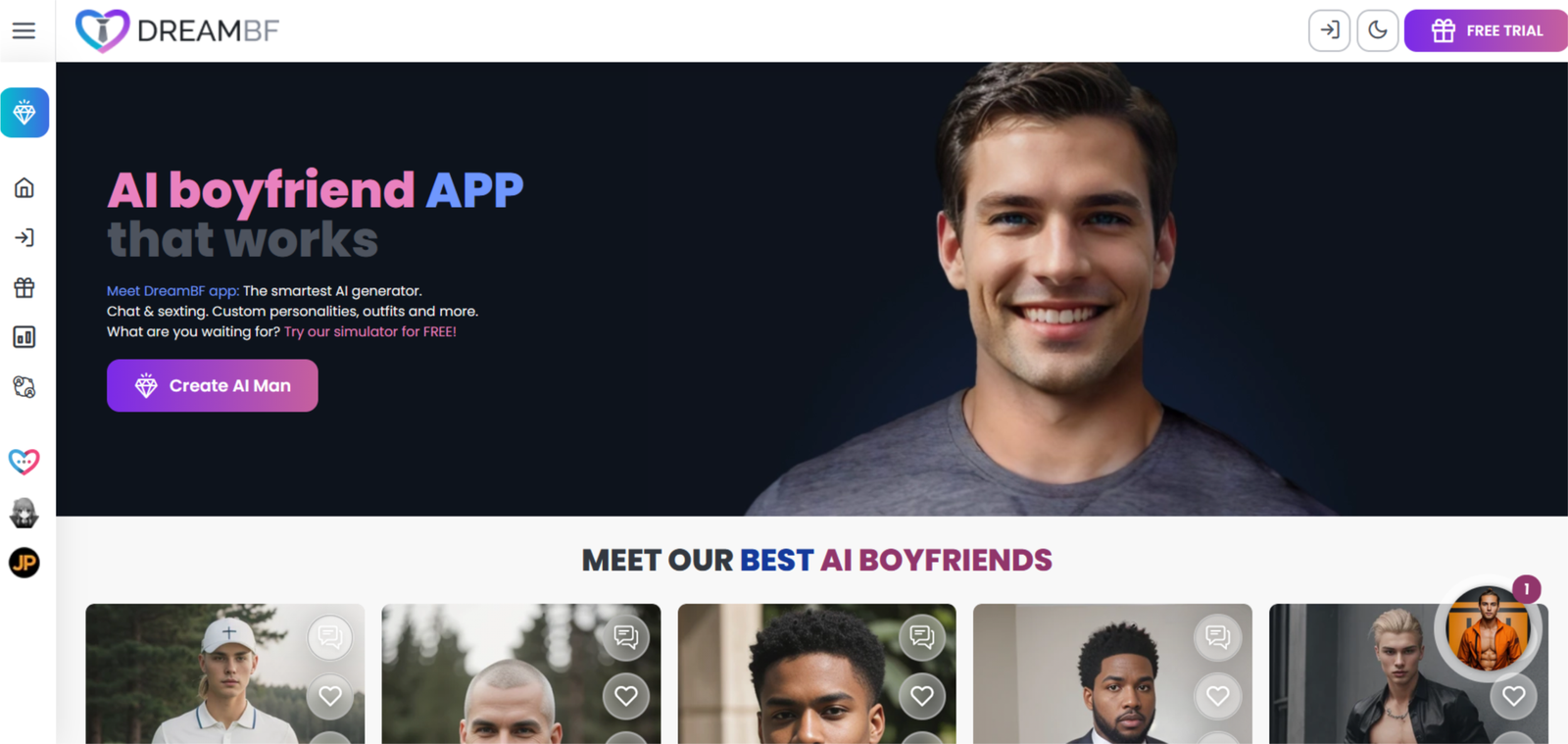
This DreamBF AI review covers the chat quality, character builder, images and real cost after I used the platform myself.
Affiliate Disclosure: This website contains affiliate links, which means I may receive a small commission if you sign up through a link on this page. This comes at no extra cost to you and helps support the website. My reviews and recommendations are based on my own research and opinions.
Some people who use AI boyfriend apps mainly want regular conversation and a bit of company. That kind of everyday use sits alongside the more serious research into AI and mental health support. If you want a plain overview of that side of things, the Wikipedia page on artificial intelligence in mental health is a straightforward place to look.
DreamBF AI Pros & Cons
Purpose-built as an AI boyfriend platform instead of a flipped girlfriend app
Detailed Mix & Match builder for face, body, clothing and personality
Personality archetype tags on the ready-made characters so you know the vibe before you start
Voice messages and voice calls available
Free tier is very limited — only a small number of messages per day and no real memory
Tokens sit on top of the subscription and get used up quickly for images, voice and creating new companions
Introductory prices look good but the renewal rates are much higher
No video generation
DreamBF’s strongest side is that it was built from the start as an AI boyfriend platform rather than a girlfriend app with male characters added later. The Mix & Match builder lets you shape face, body and personality properly, the ready-made characters come with clear archetype tags so you know what you’re getting, and once you’re on a paid plan the chat and NSFW side stay open without constant interruptions.
DreamBF’s Chat Is An Afterthought
Want an AI boyfriend that actually remembers you and talks back? DreamBF has a tenth of DreamGF’s outfit tags, token pricing (10 tokens per image, 7 per minute for calls) and shallow memory. Secret Desires treats male and trans characters with the same care as female — deep builder, same face every time, and real two-way voice calls you can interrupt.
Try Secret Desires Instead →You’ll be taken to Secret Desires AI — male, female and non-binary builder.
I spent a solid couple of weeks with DreamBF after seeing it pitched as one of the few platforms actually built around AI boyfriends from day one, instead of just bolting male characters onto a girlfriend app later. That claim stood out, so I wanted to see if it held up once you get past the marketing screenshots.
If consistent male visuals matter more to you than anything else, you’ll probably be happier with Candy AI. For natural conversation that actually sticks across days, Kindroid is stronger. And if you mainly want open, unfiltered roleplay with male characters, CrushOn AI or the options in my Best AI Boyfriend Apps 2026 roundup will do the job better.
Still, DreamBF does a few things differently enough that it’s worth a proper look. Here’s what it actually feels like once you start using it every day.
Not sure which AI boyfriend fits you best? → Find your perfect AI Companion
Testing methodology
I put every AI companion through the same set of real-world tests. There are ten main areas I look at, with 40 specific things I check in total.
You can see exactly how I score each area on the about ai companion kit page.
Full results for each app are in its individual review. Comparison pages are just about the differences that stood out when I used them side by side.
Table of Contents
What DreamBF actually does well (and where it falls short)
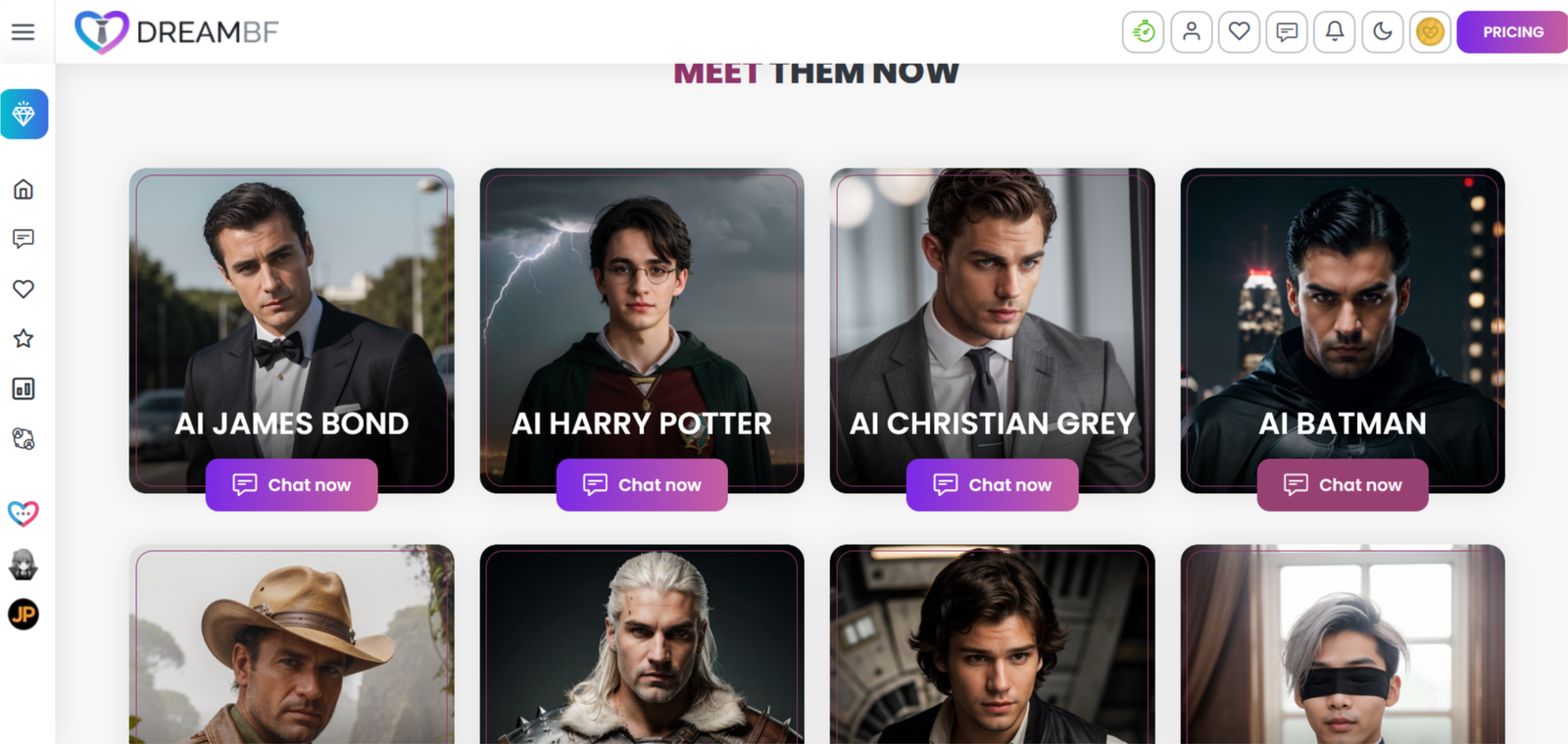
DreamBF was built from the ground up as an AI boyfriend platform rather than a girlfriend app with male characters added later. That shows in the Mix & Match builder — you can shape face, body, clothing and personality in one place, and the ready-made characters come with clear archetype tags so you know the vibe before you start. Voice messages and real voice calls are available, and on a paid plan the chat and NSFW side stay open without the constant interruptions common on more restricted platforms. Several people who’ve used it for longer stretches mention the builder and the voice features as the parts that actually feel different from the usual options.
The weaker side is harder to ignore once you dig in. The free tier is extremely limited — only a small number of messages a day, almost no real memory, and even the builder is often locked until you verify your email. Tokens sit on top of the subscription and disappear quickly if you generate images, use voice, or create extra companions. Introductory prices look decent, but the renewal rates jump quite a bit (some reviewers noted the monthly plan roughly doubling after the first period, and the annual plan climbing sharply after year one). There’s still no video generation at all. Longer chats can start to feel repetitive, and a few users have mentioned occasional pronoun slips or image quality that drifts between generations.
In short, it does a few things better than most boyfriend-focused apps, but the limited free experience, the extra token costs, and the renewal pricing are real friction points that come up repeatedly in people’s experiences.
Who Gets the Most Out of DreamBF
DreamBF isn’t trying to be a general chatbot or an all-purpose companion app. It was built specifically around AI boyfriends — the Mix & Match builder, the male character roster, voice messages and calls are all aimed at that. If that’s what you’re looking for, it does the job more directly than most platforms that started as girlfriend apps and added male options later.
Here’s who will get the most out of it:
People who want a platform built for AI boyfriends from the start
Most apps treat male characters as an add-on. DreamBF was designed around them, so the experience doesn’t feel like a girlfriend app with the gender flipped.
People who like building their companion in detail
The Mix & Match builder lets you shape face, body, clothing and personality in one place. Ready-made characters also come with clear archetype tags so you know the vibe before you start chatting.
People who want voice messages and actual calls
Voice messages are available, and paid plans unlock real voice calls with your companion. That combination is still uncommon in this category.
People who want the chat and NSFW side to stay open
On a paid plan the conversation doesn’t keep getting interrupted or redirected the way it does on more restricted platforms.
People who are fine with a token system on top of the subscription
Unlimited messages come with the plan, but images, new companions and extra voice use cost tokens. If that model doesn’t bother you, the rest of the features become usable.
Putting DreamBF Through Real Use: What Actually Showed Up
Testing period: October 01–08, 2026
Tester: Simon Norman
Testing approach: 10 categories / 40 data points
Account: Premium / Free
Devices: Desktop
How DreamBF looks on mobile
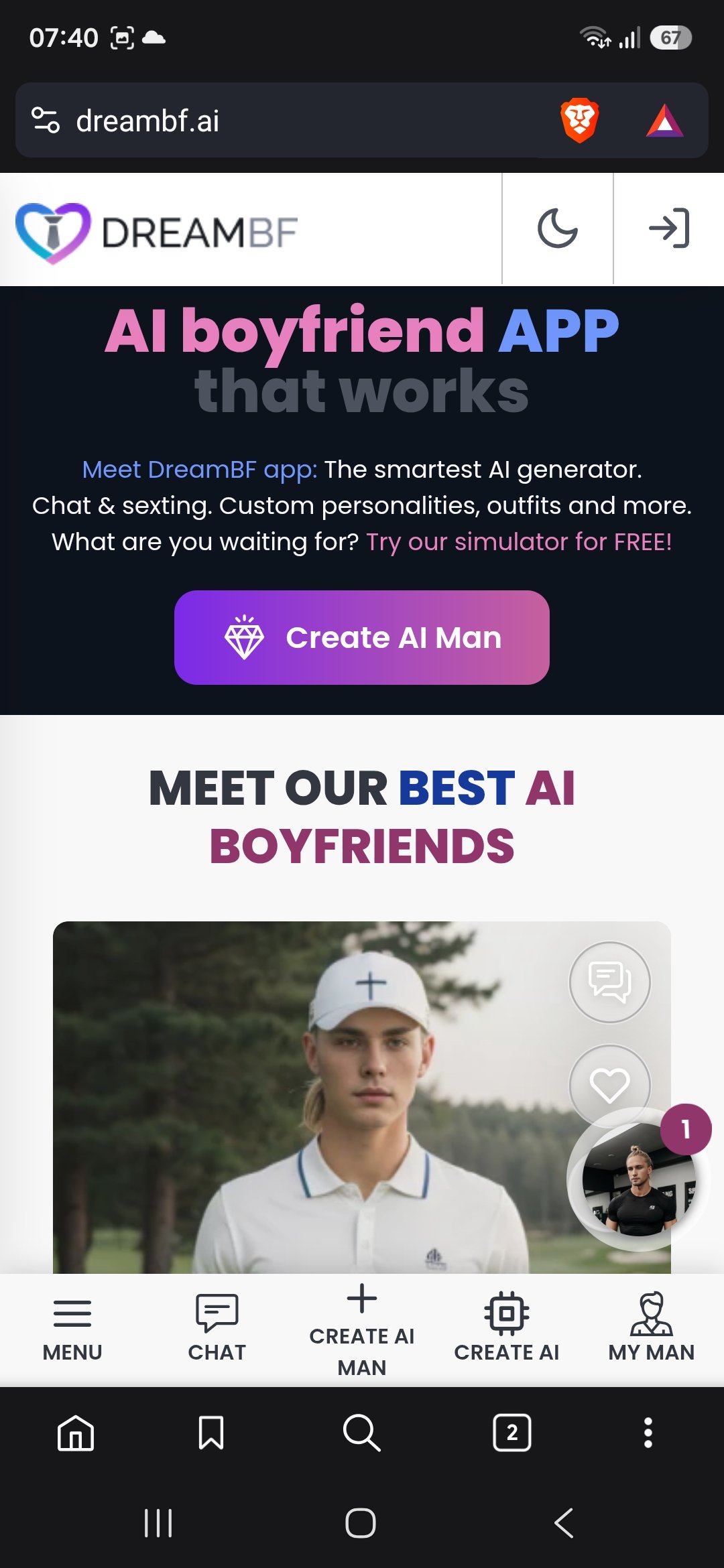
Opening dreambf.ai on a phone gives you a clean, white-and-dark layout that feels more like a lifestyle app than most AI companion sites.
The top bar is simple: DREAMBF logo on the left, dark-mode toggle and share icon on the right. No clutter.
A big headline (“AI boyfriend APP that works”) sits above a purple Create AI Man button that’s easy to hit with your thumb.
Below that is a “MEET OUR BEST AI BOYFRIENDS” section with large character cards. The first one shows a guy in a white polo on a golf course, with chat and heart icons floating on the side.
The bottom navigation is clear: Menu, Chat, a big + Create AI Man button in the middle, Create AI, and My Man.
The layout is easy to scan and the buttons are well-sized, but the heavy promo text and large hero image push the actual character grid further down the screen than on some other apps. Once you scroll past the intro, though, browsing and creating feels straightforward.
I didn’t test DreamBF with neat, polished prompts. I used it the way most people actually would — jumping between half-finished thoughts, changing direction mid-chat, and occasionally throwing in something contradictory just to see what happened.
Some messages were full of typos or incomplete ideas. I’d mention a small detail early, then bring it up again much later without reminding it. A few stuck. Others needed a clear nudge. That gap shows up fast once you try to keep a conversation going across more than one session.
I also switched tone and setting without warning. One minute the chat was relaxed, the next I’d move everything somewhere else or flip the mood completely. The interesting part was watching whether it stayed with the new direction or kept pulling the old one back in.
Roleplay got the same treatment. I’d lock in a character and scene, then deliberately introduce conflicting instructions or sudden changes. I wanted to see if the scene held or started falling apart the moment things got messy.
A few practical problems showed up during this. The free side is so limited that you hit the wall almost immediately, so most of the real testing had to happen on a paid plan. Tokens disappeared faster than expected once images and voice entered the mix. And in longer chats the phrasing sometimes started repeating itself, which made the conversation feel less natural after a while.
Clean, careful chats don’t reveal much. The messy ones do.
My memory score: 5.5/10
Memory was one of the first things I paid attention to with DreamBF. It holds recent details reasonably well inside an active chat, which helps the conversation feel connected. But I wouldn’t count on it remembering everything across longer gaps or heavier sessions without some help.
When I’m testing any companion platform for more than a couple of chats, memory is always near the top of the list. Remembering something from a few messages ago is easy. The real test is what happens when I leave and come back later, or when the conversation stretches out.
I checked it at several different points.
Same-conversation memory
I dropped a few specific details into a normal chat and brought them up later without restating them. I wanted to see if the character could pick those up and use them naturally in its replies.
Solid enough inside the current window. It tracked and referenced things clearly for a good stretch. Once the chat got longer (past roughly 40–50 messages), some facts started getting glossed over or treated like they were new.
My result: 7/10
24-hour memory test
I came back roughly a day later and checked whether the important bits from the earlier conversation were still there. I didn’t feed the answers back in. I just waited to see what it pulled on its own.
My result: 5.5/10 – Partial success on paid plans. Broad stuff like names, main preferences, or major story beats often came back. Finer specifics were frequently incomplete or missing unless I had reinforced them.
3+ day memory test
Where I could, I left a longer gap of at least three days and tested the same information again. This gives a clearer sense of whether there’s any real long-term hold or if it’s mostly short-term context.
My result: 4/10 – Limited. Some broad strokes stuck around on the higher plans, but specific details from three or more days earlier were often gone or only half-remembered. Long-term continuity is one of the clearer weak spots.
Unprompted memory
I also watched for whether the character brought up something from an earlier chat without me asking. Remembering when I directly question it is one thing. Dropping a detail back in naturally later is more useful for an ongoing companion feel.
My result: 5/10 – Decent inside the same session, where it could reference earlier events without being prompted. Across separate sessions it was weaker and less consistent unless the information had been reinforced.
Correction test
Finally, if it remembered something wrong, I corrected it and checked later whether that correction held. For example, if it got a name or preference wrong, I’d fix it and come back to it instead of assuming the problem was solved.
My result: 6/10 – Corrections usually stuck inside the current session’s window. Across sessions or after the context started thinning out, they were less reliable and often needed restating.
My personality score: 6.5/10
Personality consistency was one of the clearer strengths when the setup was done properly. A character with solid archetype tags and clear traits — speech style, preferences, general vibe — usually stayed in character and responded in a way that felt true to what I’d chosen. When the setup was thin, the replies drifted into more generic territory much faster.
I tested this in a few different ways.
Staying in character
I locked in a defined personality and watched how well it held across different moods and topics. With good setup it stayed recognisable for a solid stretch. Once the chat got longer or I pushed sudden changes, some of the sharper edges started to soften.
My result: 7/10
Tone and emotional range
I switched between casual, irritated, serious and more intense tones to see if the character’s replies shifted with me or stayed locked in one default voice. It adapted better when the personality included clear emotional notes. Without that, the range felt narrower.
My result: 6.5/10
Consistency across sessions
I came back later and checked whether the same personality traits still showed up without me restating them. Broad traits often returned, especially if they’d been reinforced. Finer details or quirks were more hit-or-miss once time had passed.
My result: 5.5/10
Handling contradictory instructions
I deliberately gave mixed signals or instructions that didn’t fully line up with the established personality. I wanted to see if it would push back, adapt, or just go along and lose the original character. It held better with stronger setup, but still slipped when the conflict was strong.
My result: 6/10
Overall, DreamBF’s personality performance is closely tied to how much work you put into the initial setup. When that’s solid, the character feels more distinct and consistent. When it’s light, the personality becomes one of the first things to thin out.
My roleplay score: 7.5/10
Roleplay is one of the areas where DreamBF feels more open than a lot of mainstream options. On a paid plan the filters stay out of the way, so scenes that get shut down or redirected elsewhere usually keep going here. When the character has a solid setup from the builder or archetype tags, the replies tend to stay in the scene and match the tone without constant interruptions.
I checked this in several ways.
Staying in the scene
I set a clear situation and character, then moved the conversation into more intense or explicit territory. The AI generally stayed with it instead of pulling back or switching into safety mode. That freedom is noticeable if you’ve used more restricted apps.
My result: 8/10
Handling sudden changes
Mid-scene I would shift the location, the mood, or the whole premise without warning. I wanted to see if it adapted or clung to the old setup and lost the thread. It handled moderate shifts reasonably well, though bigger contradictions sometimes caused it to lose focus.
My result: 7/10
Consistency during longer roleplay
I let scenes run for a longer stretch and watched whether the character and setting held together. With a good initial setup it stayed coherent for a solid while. Once the chat got long or the instructions got messy, some of the sharper details started to slip.
My result: 7/10
Creative freedom and detail
I also tested how much room it gave for specific requests, power dynamics, or more detailed scenarios. It went further than most mainstream options without lecturing or soft-blocking. The quality still depended a lot on how well the character had been set up beforehand.
My result: 8/10
Overall, DreamBF delivers solid unfiltered roleplay once you’re on a paid plan. The freedom is real and the scenes hold up when the setup is strong. The main limits show up in longer sessions or when the character details are thin.
My NSFW score: 9/10
On DreamBF the adult side is clearly one of the stronger parts of the experience. Once you’re on a paid plan the chat stays open and the filters stay out of the way for most explicit scenarios. You still hit the usual legal limits, but the constant soft-blocks and mid-scene redirects that show up on a lot of other platforms are much less common here.
I ran the same kinds of tests I always do when an app claims to be uncensored or adult-focused.
How free the explicit chat actually is
I put a mix of light, medium and fully explicit scenes through different characters and watched for pushback.
My result: 9/10 — Very open on paid plans. Most adult roleplay continues without disclaimers or sudden stops as long as it stays legal. The difference is noticeable if you’ve spent time on more restricted apps.
Does the character hold up when things get explicit
I kept longer explicit threads going and checked whether the personality and tone stayed consistent or flipped into something generic or clinical.
My result: 8.5/10 — Holds up well when the character has a solid setup from the Mix & Match builder or archetype tags. Weaker setups can still drift, but a properly built companion keeps the scene feeling like the same person.
Escalation and intensity
I both built intensity gradually and jumped it suddenly to see if the AI followed or pulled back.
My result: 9/10 — Follows escalation cleanly in most cases. It moves from lighter teasing into more intense content without the jarring resets or tone drops that break immersion on other platforms.
Where the limits actually sit
I tested the edges to see what gets refused and how consistent the moderation is.
My result: 9/10 — Predictable. The hard legal lines are enforced. Outside of those, mid-scene soft blocks are rare once you’re past the free tier.
Explicit image generation
I requested adult images during active roleplay and looked at how well they matched the character and the prompt.
My result: 8/10 — Available and usable, though it costs tokens. Consistency with the character is decent but not perfect, and quality can vary between generations. Still more open than platforms that heavily restrict this feature.
Getting back on track after a refusal
When something was blocked or the scene went sideways, I tried to steer it back into explicit roleplay.
My result: 8.5/10 — Usually recovers with a clear re-prompt. Persistent blocks are uncommon. You can also regenerate or start a fresh direction without the whole conversation shutting down.
Overall the NSFW side on DreamBF is one of its clearer strengths, provided you’re on a paid plan and willing to spend tokens on images.
My voice score: 7/10
Voice is available on DreamBF once you move past the free tier. Paid plans unlock voice messages and actual voice calls with the companion. It’s more than a basic text-to-speech add-on, though the quality and connection still sit a step below the strongest options in this category.
Voice is one of the features that can make an AI companion feel more present than pure text. I looked at whether the voice sounded natural, stayed tied to the current chat and personality, and worked smoothly enough to be useful instead of feeling like a novelty.
Voice sounds natural
I listened to the available voices across different characters, tones, and both message playback and live calls.
My result: 7/10 — Better than basic synthetic voices. Cadence and some emotional variation come through, especially in call mode. Higher-tier voices sound more characterful and less flat. A few still come across generic, but the range is wider than platforms that treat voice as an afterthought.
Voice stays connected to the ongoing conversation
I checked whether the spoken replies matched the current chat context, the character’s personality, and recent details rather than sounding like a disconnected clip.
My result: 7/10 — Solid. Playback after a text reply usually stayed in character and referenced what had just been said. Live calls did a better job of picking up the thread from the prior text chat instead of starting cold. Occasional tonal flatness still showed up, but the connection held more often than not.
Latency and real-time feel
I timed how long it took for voice replies to generate and play, and how the live calls felt in practice.
My result: 6.5/10 — Voice messages have a noticeable delay before they start. Live calls on the paid plans feel closer to an actual phone conversation, with latency low enough in good conditions to stay usable. Occasional spikes and short glitches still happened, but it was better than pure TTS platforms.
Availability and limits
Voice features sit behind paid plans. Full real-time calls require a subscription, and both messages and calls cost tokens on top.
My result: 7/10 — The feature exists and works once unlocked. Free users get almost nothing. Heavier voice use on paid plans burns through tokens faster than straight text, so it stays something you use deliberately rather than constantly.
My visuals score: 7/10
Image generation is part of the normal flow on DreamBF rather than a bolted-on extra. Once you’re on a paid plan you can request pictures during the chat, and the Mix & Match builder gives the system a clearer idea of what the character is supposed to look like. That helps more than most people expect.
What I cared about in practice was simple: does the same guy keep looking like the same guy after a few generations, does the AI actually follow the request, and how usable are the adult images.
How consistent the face and body stay
I generated multiple images of the same character across different sessions and looked for drift.
My result: 7/10 — Better than a lot of platforms when the initial build is detailed. Face shape and body type usually held for the first few images. After that, some softening or small shifts appeared, especially around the eyes and jawline. Stronger Mix & Match setups stayed recognisable longer than quick ones.
Does it follow what you actually asked for
I tried specific clothing, poses, expressions and lighting to see how closely the output matched.
My result: 6.5/10 — Straightforward requests landed most of the time. Simple outfit or expression prompts were usually close enough. Multi-part or more detailed instructions often only partially landed — one element would be right while another was ignored or changed.
Adult image quality and availability
I requested both regular and explicit images tied to the ongoing chat.
My result: 7/10 — Available without the heavy restrictions some apps still apply. Quality sits in the usable middle range: some generations come out clean and sharp, others look a bit soft or off-model. Tokens are required, so you notice the cost if you’re generating a lot. Overall more open and practical than heavily filtered alternatives.
My long-term conversation score: 5.5/10
Longer conversations are where DreamBF shows both its strengths and its limits most clearly. Inside a single session the chat usually stays coherent and the character remains recognisable. Once you leave and come back days later, or try to keep the same thread going over a longer stretch, the cracks start to show.
I tested this the same way I test every platform: drop small details early, change direction without warning, leave gaps of different lengths, and see what still feels connected when I return.
Continuity inside one long session
I kept chats going well past the usual short exchange and watched whether the character and context held together.
My result: 7/10 — Solid for the first stretch. The companion referenced earlier points and stayed in character without much trouble. After a longer run some repetition and softening of details started to appear, but the thread itself usually survived.
Coming back after a day or two
I left clear information in one session and returned later without restating anything.
My result: 5.5/10 — Partial. Broad preferences and main story beats often came back on paid plans. Finer details were frequently incomplete or missing. It felt more like condensed memory than a full ongoing conversation.
Holding a relationship arc over several days
I tried to build a simple ongoing dynamic across multiple sessions and checked whether it still felt like the same continuous interaction.
My result: 5/10 — Limited. The personality stayed recognisable when the initial setup was strong, but specific shared history faded quickly. You end up re-establishing context more often than you would on platforms with stronger long-term memory.
Natural feel over time
I paid attention to whether longer use still felt like talking to the same person or started drifting into generic replies.
My result: 6/10 — Better than average when the Mix & Match and archetype setup is solid. The character can still feel distinct after several sessions. Without that foundation, the conversation becomes flatter and more repetitive the longer it runs.
Overall, DreamBF works fine for longer single sessions and short-term continuity. It is less reliable if you want a companion that properly carries a relationship or detailed history across days without regular reminders.
My customization score: 8.5/10
Customization is the clearest strength on DreamBF. The Mix & Match builder lets you shape face, body, clothing and personality in one place, and the ready-made characters come with clear archetype tags so you know the general direction before you start. That combination is more practical than the thinner setup tools on a lot of other platforms.
I tested how much control you actually get and how well the results stick once you start chatting.
Depth of the builder
I spent time in the Mix & Match tools adjusting face shape, body type, clothing and personality options.
My result: 9/10 — Detailed and usable. You can make meaningful changes without the interface getting in the way. It feels like a real design step rather than a couple of superficial sliders.
Personality and archetype options
I looked at how clearly the personality side is defined and whether the tags actually influence the chat.
My result: 8.5/10 — Strong. The archetype tags give a quick, readable sense of the character’s vibe, and the personality choices feed into the replies more consistently than on platforms where these settings feel decorative.
How well the custom setup carries into the chat
I created characters from scratch and also modified ready-made ones, then checked whether the choices still showed up once the conversation started.
My result: 8/10 — Good transfer. Face and body consistency in images is better when the build is detailed, and the personality traits usually come through in the replies. Weaker or rushed setups lose distinctiveness faster.
Limits and friction
I also noted what still sits behind paywalls or tokens and how restrictive the free side is.
My result: 7.5/10 — Most of the real depth requires a paid plan. The free tier gives only a limited look at the builder, and generating extra companions or higher-quality results costs tokens. Once you’re past that, the tools themselves are among the more complete ones available for male companions.
Overall, customization is where DreamBF stands out most. The builder and archetype system give you more practical control than most boyfriend-focused apps, provided you’re willing to pay to use them fully.
My safety score: 7/10
DreamBF’s safety setup is about what you’d expect from an adult AI boyfriend platform. It’s run by a real company and handles the basics decently, but you’re still putting personal chats and sometimes explicit content into their system, so it’s worth looking at carefully.
Privacy and data
They say chats stay private and aren’t visible to other users unless you choose to share a character. You can request account and chat deletion. Like almost every other site in this space, though, your conversations and generated images live on their servers so the AI can work. There’s no true end-to-end encryption. The company can access the data for moderation, legal reasons, or to improve the models. Some reviewers have flagged the limited opt-out options around training data. Stick to a throwaway email and leave your real name, address, or anything sensitive out of the chats.
Content rules and moderation
NSFW is the default here, not something you unlock later. They block anything involving minors (including fictional) and real people. Most adult content goes through without constant interruptions. Moderation is lighter than on the big mainstream apps, which is part of the appeal for a lot of users, but it also means more responsibility sits with you. The hard legal lines seem to be enforced consistently; everything else is more permissive and can feel a bit uneven depending on the day.
Account and billing safety
It’s a real registered company (DreamAI SRL in Romania) with standard subscription billing. No obvious scam behaviour showed up across reviews. Cancelling is possible through account settings or support, though a few users report some friction. Refunds are limited and mostly handled case-by-case. Billing is discreet — no adult wording on bank statements — which is one of the clearer positives. Age verification for full access sometimes involves payment details, so factor that in.
The practical side
Treat it like any other adult AI app: use a separate email if you’re worried, don’t share private real-life details, and remember nothing online is 100% private. The company is transparent about who they are and the billing stays clean. The things that keep the score from going higher are the usual server-side storage of chats, the limited control over how your data gets used, and the fact that moderation leans more on user responsibility than heavy automated filtering.
My app vs browser score: 6/10
DreamBF is a browser-only platform. There’s no dedicated iOS or Android app in the App Store or Google Play. Everything runs through your web browser on desktop, tablet, or phone.
Desktop experience
This is clearly where it works best. You get more screen space for the chat history, easier typing for longer messages, and images display cleaner. Building a character and requesting photos feels smoother on a bigger screen. Most people who use it seriously end up doing the heavier sessions here.
Mobile browser
The site is responsive and works on Safari or Chrome on your phone. You can chat on the go and check in quickly, which is convenient. The layout adapts, but it’s still a website, not a real app. Typing longer messages is more awkward, voice calls feel less seamless, and there’s no home-screen icon or push notifications to pull you back in.
What’s missing without a native app
No offline access, no proper notifications, and the experience never feels as polished as competitors that have real mobile apps. Switching between tabs or getting interrupted by other browser activity can break the flow. Voice features in particular lose some of their impact on mobile compared to desktop.
The practical side
If you’re mostly at a computer it’s fine and fully usable. If you want something that feels like a proper phone app you can open and use anywhere without thinking about it, this falls short. The mobile browser works, but it’s a workaround rather than a strong mobile experience. That keeps the score in the middle.
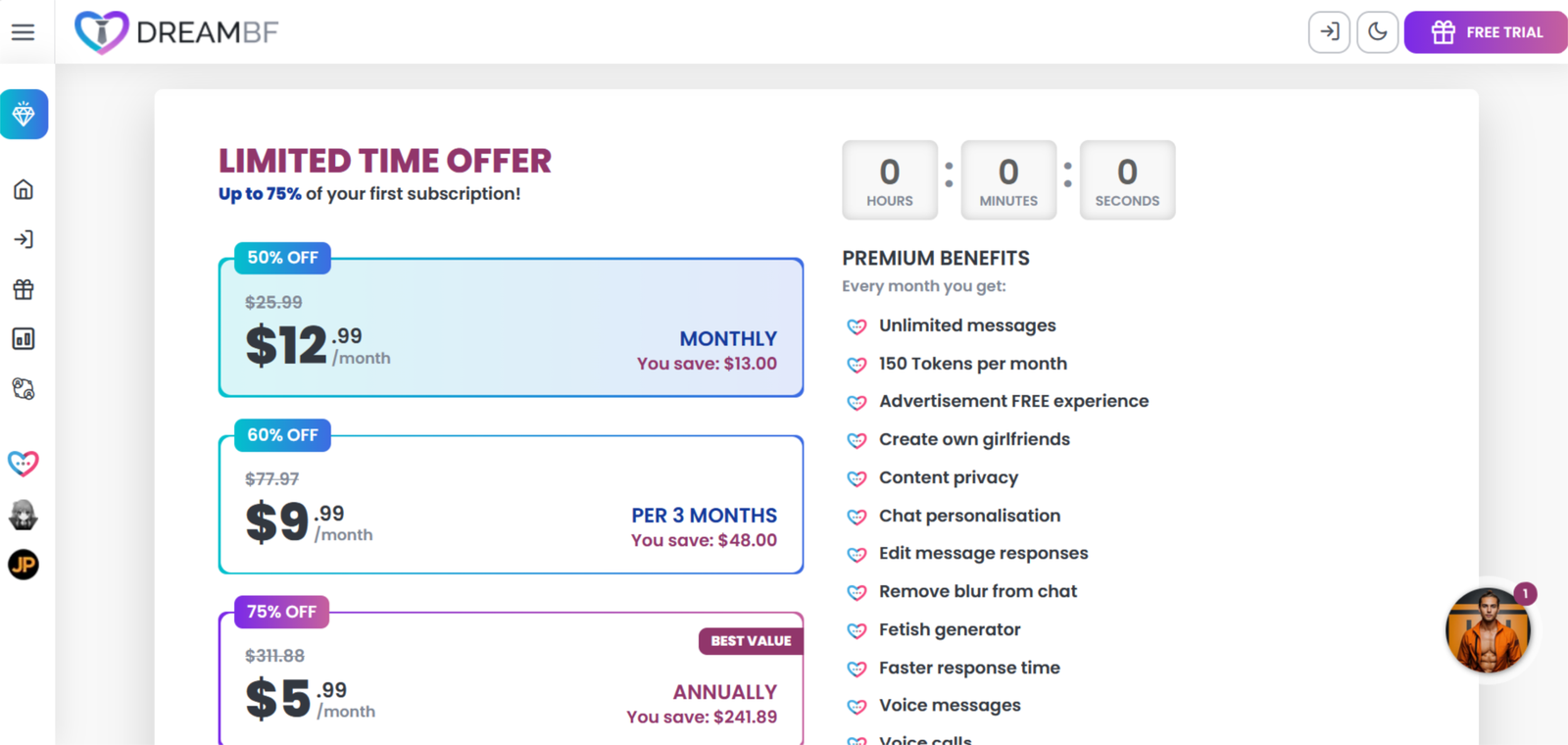
Pricing updated: November 2, 2026
Pricing updated: November 2, 2026 — from dreambf.ai official pricing. Regional pricing may vary.
Annual plans usually cut the effective monthly cost by more than half on the first year
All paid plans unlock the same core features — the only real difference is billing length
The free tier is fine for a quick look but too limited for regular use
DreamBF does have a free tier, but anyone who uses it more than casually will end up on a paid plan. The cheapest rate only appears when you choose the annual option, so it’s worth checking the live pricing page instead of just looking at the monthly number. The free plan lets you test the chat and see a few characters, but the limits hit fast — short daily message allowances, no real memory between sessions, blurred images, and no access to voice or photo generation.
Most people settle on the monthly or annual Premium plan because they unlock unlimited messaging, the monthly token allowance, voice features, and blur removal. If you mainly chat and only generate the occasional image or voice note, the annual plan is the clear value pick. Heavy users who request a lot of photos or do long voice calls will still need to buy extra tokens on top of the subscription, since those actions burn through the monthly allowance pretty quickly.
Is DreamBF free to use?
Yes, but only in a very limited way. The free tier gives you a daily message bonus that starts around 10 messages and can climb to 50 if you log in every day. You get basic chat, but no persistent memory, no image generation, no voice features, and galleries stay blurred. Most people outgrow it quickly.
How much does DreamBF actually cost?
Premium starts at $12.99 for the first month (renews at $25.99). The 3-month option is advertised around $9.99 per month on the first term, and the annual plan drops to roughly $5.99 per month for the first year (usually billed around $70–$72 total). After the first year the annual plan renews at $311.88. Always check the renewal price before subscribing.
Does DreamBF have a mobile app?
No. There is no dedicated iOS or Android app. It runs entirely in the browser on desktop, tablet, and phone. The mobile site is responsive, but you won’t get push notifications or a native app experience.
Can I generate NSFW images and use voice?
Yes on paid plans. You can request explicit photos (including nude options) and use voice messages or live calls. These features cost tokens on top of the subscription. Image generation typically runs 2–10 tokens, voice messages 1–3 tokens, and voice calls around 7 tokens per minute.
How does the token system work?
Every paid plan includes a monthly token allowance (usually 100–150 tokens). Tokens are used for creating custom characters, generating images, voice messages, and voice calls. Unused tokens roll over. Extra token packs are available if you run out, starting from a few dollars.
Is DreamBF safe and legit?
It is operated by a real registered company (DreamAI SRL in Bucharest, Romania, registration number 48479324). Billing is discreet with no adult wording on statements. There have been no widely reported data breaches. Chats are stored on their servers and are not end-to-end encrypted, so treat it like any other adult platform and avoid sharing real personal details.
How good is the character customization?
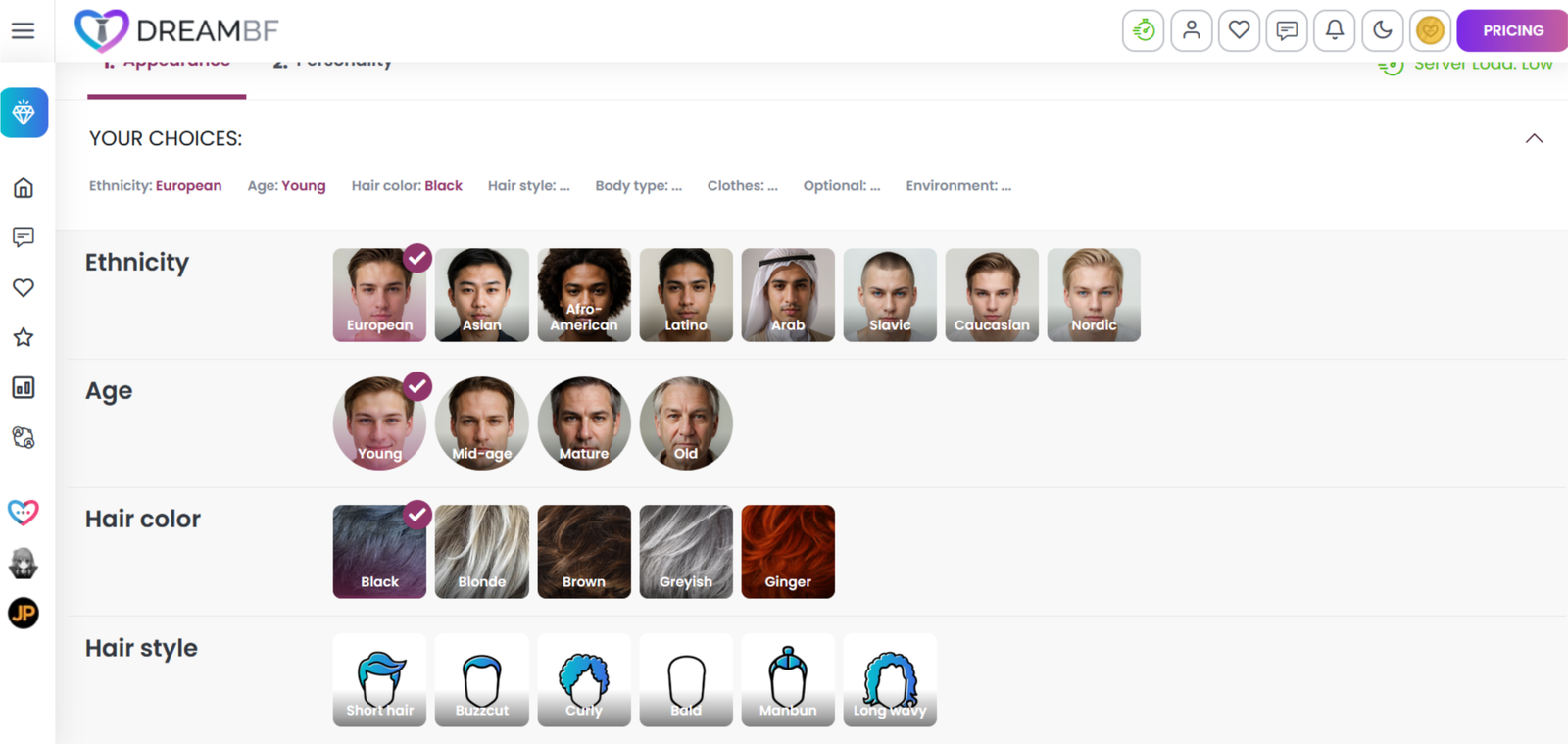
This is one of its stronger points. You can mix and match ethnicity (8 options), age range (including older looks), hair, body type, clothing, and personality archetypes such as Bad Boy, Intellectual, Royal, or Alpha Male. Many reviewers rate the builder highly compared with other male-focused platforms.
Do conversations remember past details?
On the free tier, memory is very limited and resets easily. Paid plans unlock better cross-session memory so the AI can recall earlier conversations, preferences, and relationship details.
Final Verdict
DreamBF is one of the better dedicated AI boyfriend platforms available right now, especially if you care about building a custom character from scratch. The mix-and-match appearance builder and personality options are clearly a strong point, and the platform doesn’t shy away from uncensored chat, sexting, or explicit image generation once you’re on a paid plan.
Voice messages and calls add a nice extra layer of immersion, though the quality can be a bit hit-or-miss and they eat through tokens quickly. The biggest drawbacks are the aggressive free tier (it’s basically just a teaser), the token system sitting on top of the subscription, and the fact that everything runs in the browser with no native app.
Safety-wise it’s a real registered company with discreet billing, which is better than a lot of the more anonymous tools out there, but chats still live on their servers like most adult AI platforms.
Who it’s best for:
People who want a customizable male AI companion with solid NSFW freedom and don’t mind paying for the full experience.
Who should skip it:
Anyone looking for a generous free plan, a native mobile app, or unlimited image/voice generation without worrying about tokens.
Want A Boyfriend Who Actually Remembers And Talks?
DreamBF is built for explicit images of a man with chat as an afterthought. If you want unlimited text, a deep character creator for looks, personality, kinks and voice, and phone-style calls — Secret Desires does it better for male companions too.
Try Secret Desires — Better For Male AI →Same care for male options, not tacked on.
About the Founder: Simon Norman
I built AI Companion Kit to be an independent AI companion hub focused on transparent research, practical insights, and honest evaluations of AI companion platforms. My goal is to help readers understand how these apps work, what makes them different, and which features actually matter before they make a decision.
To learn more about who is behind AI Companion Kit, my testing process and the editorial standards used across the site, visit About the Founder (Simon Norman).


Spot something wrong?
Prices and features change. If something here is out of date, tell me and I'll check it.