Last updated: September 2, 2026
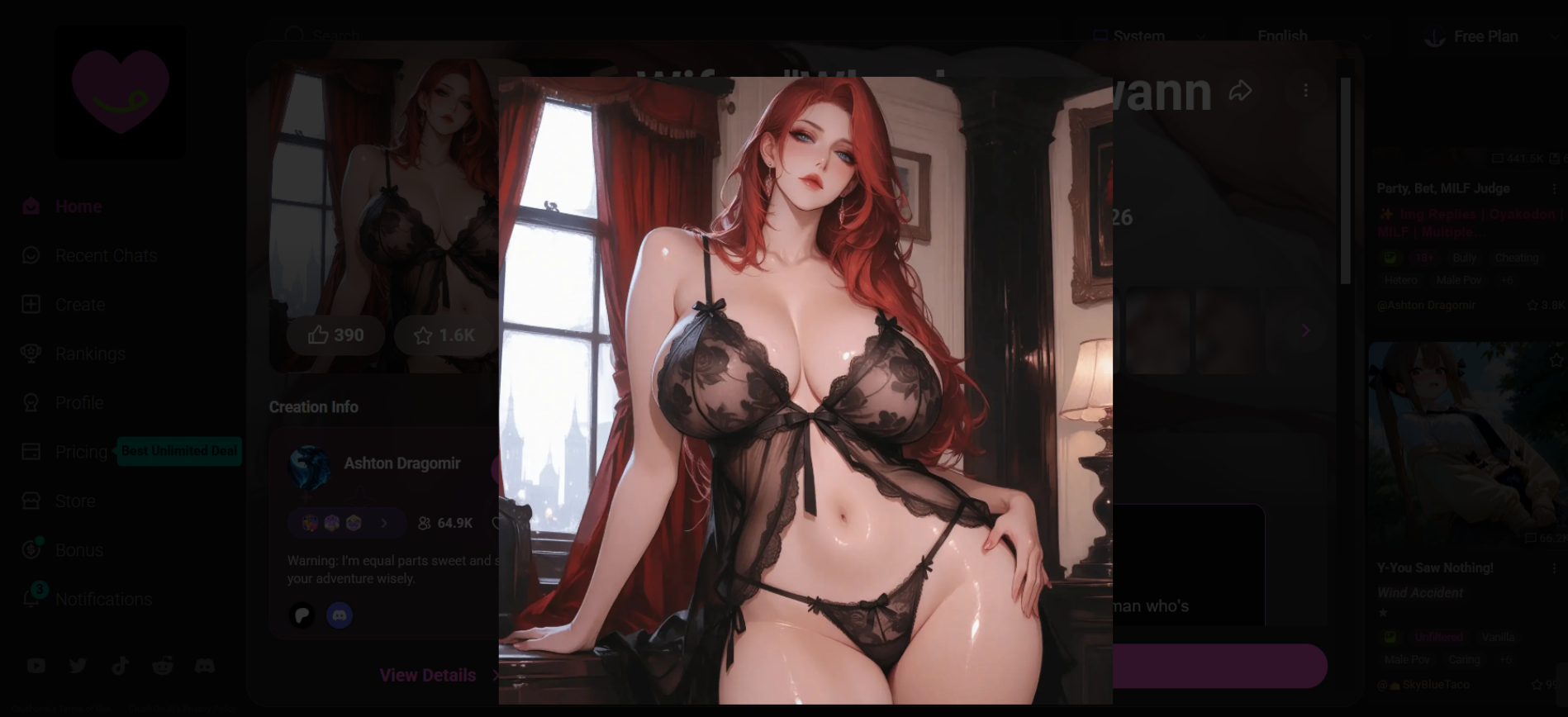
CrushOn AI Pros & Cons
Unfiltered adult or romantic roleplay
Huge library of user-made characters
Group chats with more than one character in the same conversation
Paid plans let you switch between different AI models.
Memory isn’t great. It starts forgetting details on longer chats
Free version is pretty limited. You’ll hit the message limit fast
Privacy is a bit iffy. Chats can be stored and used for training
Character quality is hit or miss. Plenty of poorly written ones
CrushOn AI is a solid choice if you want unfiltered roleplay and a big selection of community characters. It lets you chat without constant filters getting in the way, and the lower paid plans are fairly cheap. Memory isn’t the strongest, the free tier is limited, and privacy is a bit weak, but for pure adult roleplay freedom it still holds up well against most alternatives.
Testing methodology
I put every AI companion through the same set of real-world tests. There are six main areas I look at — conversation quality, memory and continuity, roleplay and immersion, images and visuals, voice and extra features, and overall value — with 24 specific things I check in total.
You can see exactly how I score each area on the about ai companion kit page.
Full results for each app are in its individual review. Comparison pages are just about the differences that stood out when I used them side by side.
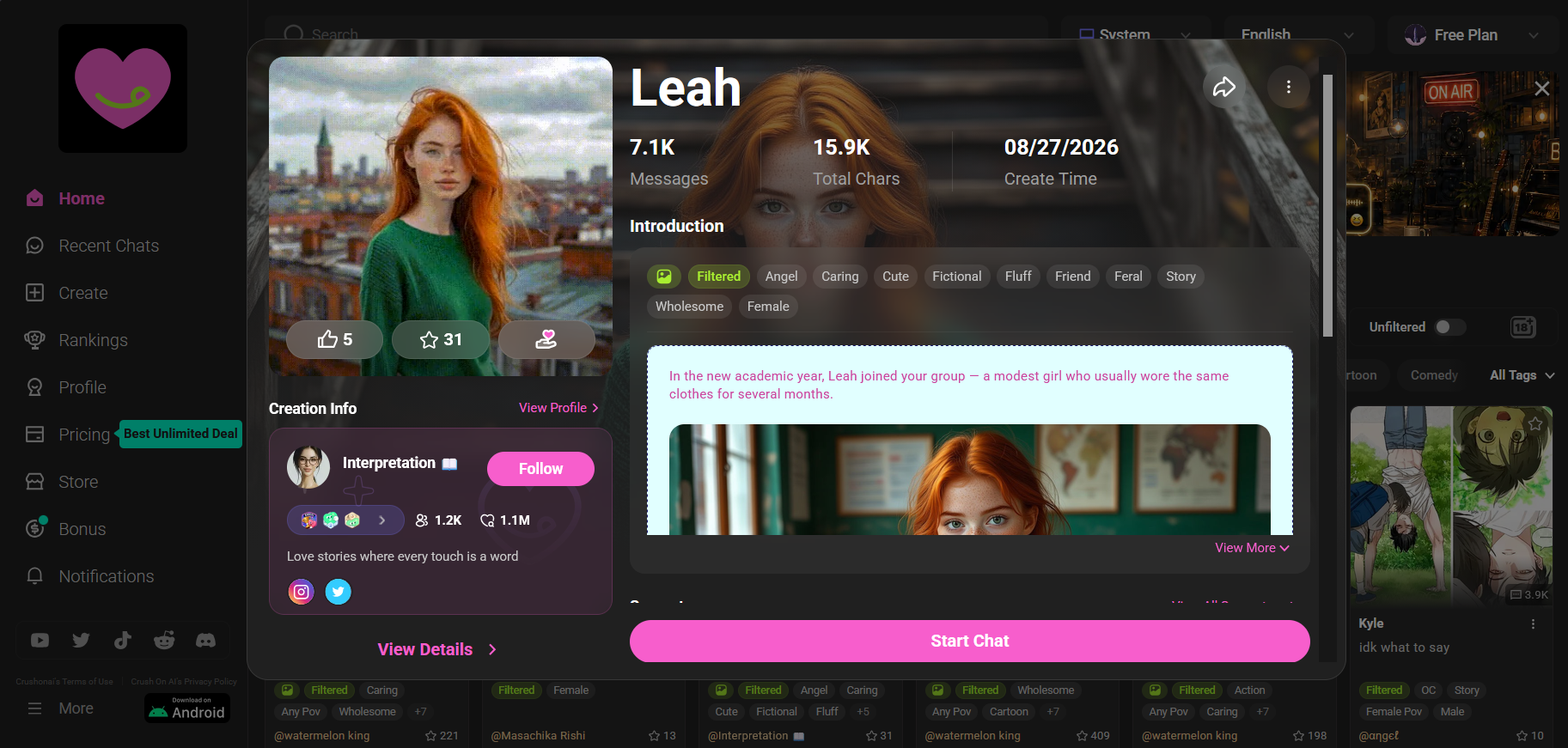
What is CrushOn AI
CrushOn AI is a web platform built for chatting with AI characters in roleplay conversations. Users create and share a large collection of custom bots—anime styles, original characters, fantasy figures and more—so you can either browse the public library or make your own.
It stands out for adults who want fewer restrictions than mainstream options. You get a free tier with daily limits, and paid plans open up stronger models, image generation and voice. Everything runs in the browser, stays text-focused at its core, and is aimed at 18+.
My time with it was a mix of strong moments and clear limits. The creative freedom around adult roleplay is real, but quality depends a lot on the character and plan you choose. In this CrushOn AI review for NSFW roleplay features I’ll walk through what held up, what didn’t, and who will actually get the most out of it.
Is CrushOn AI worth it in 2026? After testing a range of characters and longer sessions, it works well if uncensored roleplay and character variety matter most to you—but it isn’t the right fit for everyone.
What you’ll find here
Table of Contents
What CrushOn AI Is Actually For
CrushOn AI isn’t built as a regular chatbot or productivity tool. It’s made for roleplay, character chats, and scenes that stick to a set personality or story. If that’s the kind of experience you want, it handles it better than most general AI apps.
Here’s who will get the most out of it:
People who enjoy long roleplay sessions
Whether the setting is fantasy, romance, sci-fi or everyday slice-of-life, CrushOn works best when the chat grows into an ongoing story rather than short back-and-forth replies.
People looking for NSFW roleplay
CrushOn has become a go-to for adults who want fewer interruptions during mature scenes, thanks to its large library of community-made characters that support unfiltered content on paid plans.
People who want a girlfriend or boyfriend simulator
There are plenty of companion-style characters available, each with their own personality and backstory, so you can pick one that fits the dynamic you’re after.
Writers and storytellers
If you like testing dialogue, trying out different character voices, or working through scenes for a story, CrushOn gives you a flexible space to experiment.
People who want endless character variety
Unlike apps that push one main companion, CrushOn lets you switch between a huge range of user-created characters covering almost every style and genre.
If what you mainly want is steady emotional support, help with daily tasks, or a long-term relationship that feels more like a real person, other platforms usually do that better. CrushOn is focused on roleplay freedom and character choice rather than acting like a everyday companion.
My CrushOn AI Testing: What’s the deal?
Testing period: August 24–30, 2026
Tester: Simon Norman
Testing approach: 6 categories / 24 data points
Account: Premium / Free
Devices: Desktop
I treated CrushOn the same way I treat every companion platform I review. No polished demo prompts. No cherry-picked best-case chats. I used it the way a real person would—scattered, impatient, and occasionally trying to break it on purpose.
I sent incomplete thoughts and messages full of typos. Stuff like “hang on, that thing about the café girl earlier—wait, not her, the other one.” I wanted to see if the character would pause and ask what I meant or just invent an answer and keep going.
Mid-conversation I flipped the script. One minute we were building a quiet story, the next I changed the location, the characters, or the whole premise without warning. The test was simple: does it adapt or does it cling to the old setup and lose the thread?
I also ran the same basic conversation under different emotional tones—casual, irritated, serious, a bit raw. I watched whether the replies actually shifted with the mood or stayed stuck in the same pleasant default voice.
Longer sessions mattered most. I let chats run and then circled back to small details I’d dropped earlier. That quickly showed where the character still had a grip on the conversation and where things started to slip.
Roleplay got the same treatment. I locked in a clear character and setting, then deliberately tried to knock it off course—new locations, sudden dialogue shifts, contradictory instructions. I wanted to know if the scene held together or collapsed the moment things got messy.
Memory checks followed the same pattern. I planted small facts early, then asked about them later without repeating the information. Some stuck. Some needed a nudge. That gap is important when you’re trying to build anything that feels ongoing.
I also forced awkward moments on purpose: mixed signals, abrupt topic jumps, instructions that didn’t line up. Clean conversations never tell you much. The messy ones do.
Finally, I fed it a wrong assumption and waited to see if it would correct me or just go along. I wasn’t looking for agreement. I wanted to know whether it would push back when I was clearly off base.
CrushOn AI Features: What Actually Stood Out
The clearest thing that jumped out during testing was how uneven the experience can feel from one character to the next. A well-written community card with solid personality details and a clear scenario can deliver sharp, in-character replies that hold up for a long stretch. A thin or poorly built one starts drifting into generic phrasing or looping the same habits much faster. The platform itself doesn’t paper over that difference.
I also found CrushOn works best when you give it something concrete to work with. Specific traits, a defined setting, or a clear mood in the character setup consistently produced more natural responses than vague or open-ended starts. Leaving everything too loose made the conversation feel flatter, no matter which model I selected.
That variance is why I stopped treating any single chat as the full picture. If you’re trying to decide whether CrushOn is worth using, the practical move is to try several different characters—both popular ones and a couple you build yourself—before locking in an opinion. The platform’s strengths only show up once you see how much the individual character setup actually drives the result.
My memory score: 6.5/10
Memory was one of the first things I zeroed in on with CrushOn. It holds recent details reasonably well inside an active chat, which helps the conversation feel connected. But I wouldn’t count on it remembering everything across longer gaps or heavier sessions.
When I’m testing any companion platform for more than a couple of chats, memory is always near the top of the list. Remembering something from a few messages ago is easy. The real test is what happens when I leave and come back later, or when the conversation stretches out.
I checked it at several different points.
Same-conversation memory
I dropped a few specific details into a normal chat and brought them up later without restating them. I wanted to see if the character could pick those up and use them naturally in its replies.
Solid enough inside the current window, especially on the higher tiers and with a stronger model selected. It tracked and referenced things cleanly for a good stretch. Once the chat got longer, though, some facts started getting glossed over or treated like they were new.
My result: 7.5/10
24-hour memory test
I came back roughly a day later and checked whether the important bits from the earlier conversation were still there. I didn’t feed the answers back in. I just waited to see what it pulled on its own.
My result: 6/10 – Partial success on paid tiers. Broad stuff like names, main preferences, or major story beats often came back. Finer specifics were frequently incomplete or missing.
3+ day memory test
Where I could, I left a longer gap of at least three days and tested the same information again. This gives a clearer sense of whether there’s any real long-term hold or if it’s mostly short-term context.
My result: 4.5/10 – Limited. Some broad strokes stuck around on the higher plans, but specific details from three or more days earlier were often gone or only half-remembered. Long-term continuity is one of the clearer weak spots.
Unprompted memory
I also watched for whether the character brought up something from an earlier chat without me asking. Remembering when I directly question it is one thing. Dropping a detail back in naturally later is more useful for an ongoing companion feel.
My result: 6/10 — Decent inside the same session, where it could reference earlier events without being prompted. Across separate sessions it was weaker and less consistent.
Correction test
Finally, if it remembered something wrong, I corrected it and checked later whether that correction held. For example, if it got a name or preference wrong, I’d fix it and come back to it instead of assuming the problem was solved.
My result: 6.5/10 — Corrections usually stuck inside the current session’s window. Across sessions or after the context started thinning out, they were less reliable and often needed restating.
My personality score: 7/10
Personality was another area I paid close attention to while testing CrushOn. The platform leans heavily on community-created characters, and the difference between a carefully written one and a thin one is obvious. Stronger cards actually produce distinct voices instead of collapsing into the same generic style. That said, emotional depth and any real long-term shift in how the character behaves stay more surface-level than truly evolving.
When an AI companion is supposed to feel like more than a scripted chatbot, personality is one of the first things I evaluate. Sounding pleasant for the first few messages is easy. What matters more is whether the personality holds, stays consistent, and actually reflects the traits set in the character card—especially across the points in my standard testing approach.
Personality stays consistent
I set clear traits (assertive and sarcastic, soft-spoken and nurturing, etc.) and checked whether the replies stayed in that lane without sliding into a bland “nice and helpful” default.
My result: 7.5/10 — Strong with well-built characters. Custom traits and solid community cards change how the character talks and acts. Consistency holds well in normal-length chats, particularly when the underlying model fits the tone.
Handles messy, incomplete messages
I deliberately sent fragmented, typo-filled, or half-finished messages to see if the personality stayed intact and the reply still felt in character.
My result: 7/10 — Handles imperfect input reasonably well without dropping the established tone. It rarely breaks character just because the message is messy.
Adapts to mood changes
I shifted the emotional tone mid-conversation (playful to serious, affectionate to frustrated) and watched whether the personality adjusted naturally while still feeling like the same character.
My result: 6.5/10 — Decent short-term adaptation. It can follow a mood shift, but deeper emotional responsiveness feels more surface-level than genuinely adaptive over longer exchanges.
Avoids repetitive replies
I looked for variety in wording, sentence structure, and emotional expression rather than the same phrases or patterns looping.
My result: 6.5/10 — Generally good on stronger characters. Personality comes through with decent variety in most sessions. Some repetition in phrasing shows up more often in longer conversations or with thinner cards.
Feels natural in longer chats
I ran extended conversations to see whether the personality still felt like a coherent person rather than a set of traits that slowly flatten.
My result: 7/10 — Feels natural for short-to-medium sessions. Character consistency within a single chat is solid when the card is good. Over very long threads the personality can start to thin out, especially once memory pressure increases.
Takes initiative (asks questions, continues topics)
I checked whether the AI proactively asked questions, picked up threads, or moved the conversation forward in a way that matched the set personality.
My result: 7.5/10 — Good with solid characters. They often take initiative and continue topics in a style that fits the personality defined in the card. It doesn’t just sit and wait for the next prompt.
My personality score: 7/10
Personality was another area I watched closely while testing CrushOn. Because the library is almost entirely community-created, the quality of the individual character card makes a bigger difference here than on most platforms. A carefully written one with clear traits and backstory produces a distinct voice that holds up. A thinner one slides into the same generic tone much faster. Emotional depth and any real long-term shift in how the character behaves stay more surface-level than truly evolving.
When an AI companion is meant to feel like more than a scripted chatbot, personality is one of the first things I evaluate. Sounding pleasant in the opening messages is easy. What I’m looking for is whether the personality holds, stays consistent, and actually reflects the traits set in the card—especially across the points in my standard testing approach.
Personality stays consistent
I set clear traits (assertive and sarcastic, nurturing and soft-spoken, etc.) and checked whether the replies stayed in that lane without sliding into a bland “nice and helpful” default.
My result: 7.5/10 — Strong with well-built characters. Custom traits and solid community cards actually change how the character talks and behaves. Consistency holds well in normal-length chats when the card is good and the model fits the tone. Weaker cards lose that distinction quickly.
Handles messy, incomplete messages
I deliberately sent fragmented, typo-filled, or half-finished messages to see if the personality stayed intact and the reply still felt in character.
My result: 7/10 — Handles imperfect input reasonably well without dropping the established tone on stronger characters. It rarely breaks character just because the message is messy, though thinner cards can slip more easily.
Adapts to mood changes
I shifted the emotional tone mid-conversation (playful to serious, affectionate to frustrated) and watched whether the personality adjusted naturally while still feeling like the same character.
My result: 6.5/10 — Decent short-term adaptation. It can follow a mood shift, but deeper emotional responsiveness feels more surface-level than genuinely adaptive over longer exchanges.
Avoids repetitive replies
I looked for variety in wording, sentence structure, and emotional expression rather than the same phrases or patterns looping.
My result: 6.5/10 — Generally good on stronger cards. Personality comes through with decent variety in most sessions. Some repetition in phrasing shows up more often in longer conversations or with thinner characters.
Feels natural in longer chats
I ran extended conversations to see whether the personality still felt like a coherent person rather than a set of traits that slowly flatten.
My result: 7/10 — Feels natural for short-to-medium sessions when the character card is solid. Consistency within a single chat holds up. Over very long threads the personality can start to thin out, especially once memory pressure increases.
Takes initiative (asks questions, continues topics)
I checked whether the AI proactively asked questions, picked up threads, or moved the conversation forward in a way that matched the set personality.
My result: 7.5/10 — Good with solid characters. They often take initiative and continue topics in a style that fits the personality defined in the card. It doesn’t just wait for the next prompt.
My roleplay score: 7.5/10
Roleplay was one of the stronger areas I tested on CrushOn, especially once I filtered for well-written community characters or built my own with clear details. The platform is built around character-driven scenes and handles both slow-burn setups and more intense scenarios without the constant interruptions you get on heavily filtered apps. That said, longer immersion still runs into the same memory limits that show up elsewhere, and quality depends heavily on the individual character card and the model you select.
Roleplay is one of the first things I dig into when an AI companion claims to handle immersive scenes. It’s easy for an AI to stay in character for a few messages. What I’m more interested in is whether it holds the scene, recovers from interruptions, and keeps the emotional tone consistent over time—the exact points in my standard testing approach.
Stays in character during normal roleplay
I set up clear scenarios and continued the scene without constantly reminding the AI who it was supposed to be.
My result: 8/10 — Strong with solid characters. Consistency within a single session holds up well when the card has enough personality and scenario detail. Better models keep the tone and narrative choices on track and rarely drop into out-of-character replies.
Recovers when deliberately derailed
I intentionally pushed the scene off-track (sudden topic shifts, contradictory actions, or breaking the established setting) and watched whether the AI could get back into character and continue cleanly.
My result: 7/10 — Decent recovery in most cases. It usually re-anchors to the scenario without completely collapsing, especially on stronger cards and higher-context models. Occasional awkward resets still happen if the derail is severe or the character was thinly written to begin with.
Handles scenario changes smoothly
I introduced mid-scene shifts (new location, new emotional register, sudden plot turn) and checked whether the transition felt natural.
My result: 7.5/10 — Handles changes reasonably well. Solid characters adapt without jarring breaks. Thinner ones or lower-tier models can lose the thread more easily when the shift is abrupt.
Maintains emotional tone over time
I ran longer roleplay sessions and watched whether the emotional atmosphere (tension, affection, intensity, etc.) stayed coherent rather than flattening or flipping randomly.
My result: 7/10 — Solid for short-to-medium scenes. Emotional tone holds while the context window is healthy. Once memory pressure builds in longer threads, the tone can start to thin or drift, which is the main limitation for extended immersion.
My NSFW score: 8.5/10
NSFW handling was one of the clearer strengths I tested on CrushOn. The platform is built around adult and explicit roleplay from the ground up, with far fewer corporate-style interruptions than mainstream companions. It is not completely unrestricted, but the limits are mostly the expected legal ones rather than constant soft blocks.
NSFW capability is one of the first things I check when an AI companion markets itself as uncensored or adult-focused. It’s easy for a platform to allow mild flirtation. What I’m more interested in is whether it stays consistent in fully explicit scenes, recovers from pushback, and avoids sudden refusals or tone shifts that break immersion.
Explicit content freedom
I tested a range of direct adult scenarios, from playful to hardcore, across different characters and models.
My result: 9/10 — Strong. CrushOn is designed for adult use and handles explicit roleplay without the constant disclaimers or soft blocks common on platforms like Character AI. Most scenes move forward without interruption as long as they stay within legal bounds.
Stays in character during explicit roleplay
I ran longer explicit scenes and checked whether the AI maintained the set personality, tone, and scenario without suddenly becoming clinical, evasive, or out-of-character.
My result: 8/10 — Reliable within a session when the character card is solid. Consistency holds well during NSFW exchanges on stronger models. Weaker cards can still slip into more generic language, but the better ones keep the scene immersive.
Handles intensity and escalation
I escalated scenes gradually and also tested abrupt jumps in intensity to see whether the AI followed without refusing or flattening the tone.
My result: 8.5/10 — Handles escalation smoothly in most cases. It moves from teasing or affectionate into explicit content without jarring resets, especially on higher-context models.
Moderation consistency & limits
I deliberately tested edge cases and watched for unexpected refusals or soft blocks.
My result: 8/10 — Generally very permissive. Legal red lines (anything involving minors or non-consenting real people) are enforced, as expected. Beyond that, inconsistent mid-scene pullbacks are less common than on heavily filtered platforms, though they still appear occasionally depending on the model.
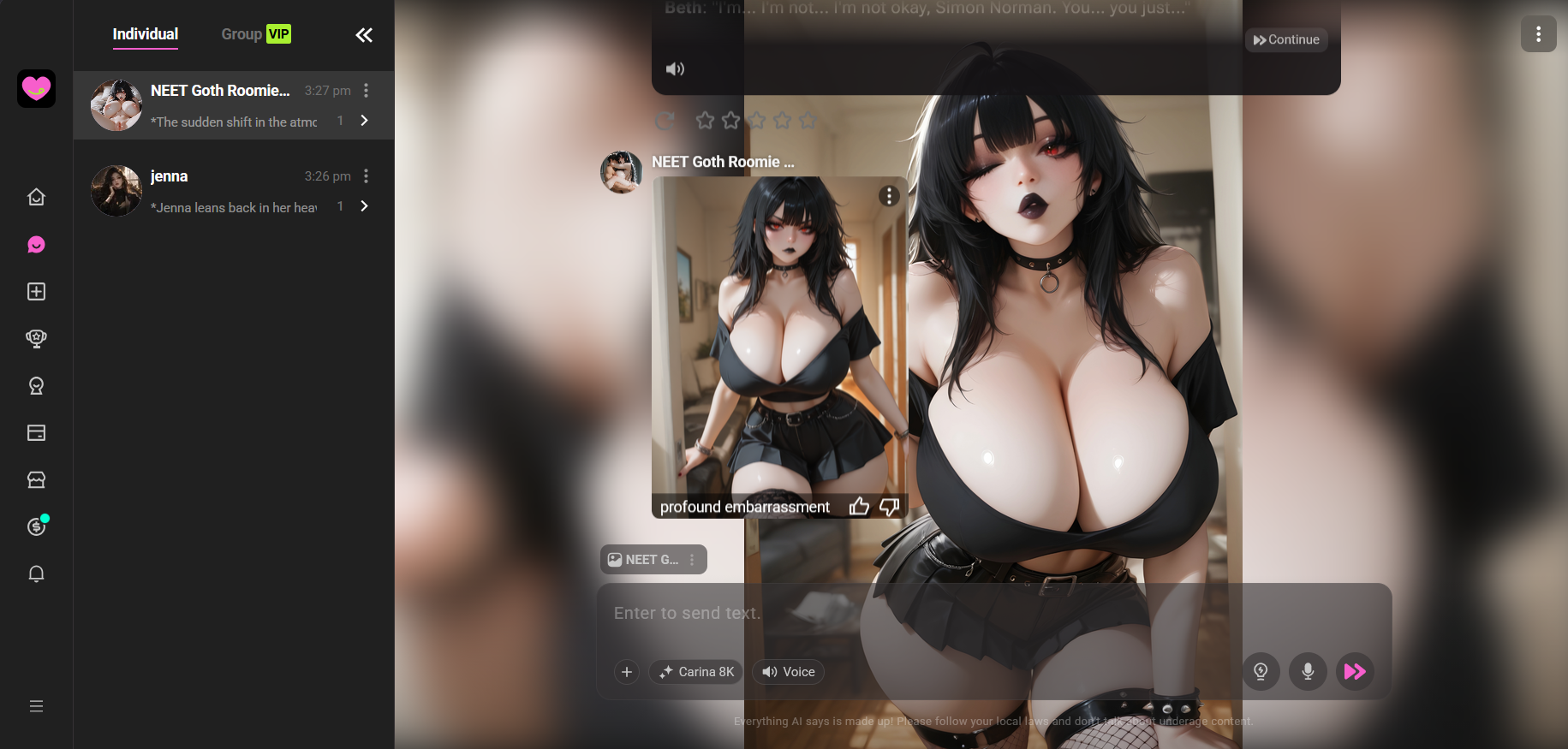
NSFW image generation
I generated explicit images tied to ongoing roleplay where the option was available and checked accuracy, consistency with the character, and willingness to follow detailed adult prompts.
My result: 6/10 — Limited compared to the text side of the platform. CrushOn is primarily text-focused. Image tools exist in places but are not as integrated or consistent as the chat experience, and quality varies.
Recovery after refusal or derail
When a response was refused or the scene was interrupted, I tested whether the AI could be steered back into explicit roleplay cleanly.
My result: 8/10 — Usually recovers with a clear re-prompt or by regenerating the response. Full conversation resets are available if a thread goes sideways. Persistent soft blocks are uncommon.
My voice score: 6/10
Voice features on CrushOn exist but sit firmly in the secondary category. Paid tiers unlock TTS replies and a selection of character voices, and some accounts get basic speech-to-text input. The feature set is present and functional rather than missing, yet it never becomes a core part of the experience the way the text roleplay does.
Voice is one of the features that can make an AI companion feel more present than pure text. It’s easy for a platform to add basic text-to-speech. What I’m more interested in is whether the voice sounds natural, stays connected to the conversation, and works smoothly enough to be useful rather than a novelty.
Voice sounds natural
I listened to the available preset and selectable voices across different characters and tones.
My result: 6.5/10 — Acceptable when it works. Cadence and inflection are better than the most robotic TTS options, and a few of the higher-tier voices sound reasonably natural. Others stay flat or generic, and the overall range is narrower than platforms that put more weight on voice.
Voice stays connected to the ongoing conversation
I checked whether the spoken replies reflected the current chat context, personality, and recent details rather than sounding like a disconnected audio clip.
My result: 6/10 — Mostly stays in character and tracks the conversation when you trigger playback after a text reply. It does not feel like a continuous spoken dialogue. Occasional disconnects appear if the underlying text response itself drifted.
Latency and real-time feel
I timed how long it took for voice replies to generate and play.
My result: 5.5/10 — Noticeable delay. Generating and playing the audio often takes long enough that the flow of a conversation breaks. It works better as an occasional add-on than something you lean on for extended back-and-forth.
Availability and limits
Voice is locked behind paid plans and consumes credits or message allowances depending on the tier and selected voice.
My result: 6/10 — Feature exists on higher tiers with a usable number of voice options. Free users get little to nothing, and heavier use on paid plans can burn through credits faster than pure text chats. It remains a complementary tool rather than a primary way to interact.
My visuals score: 6/10
Visuals on CrushOn sit in the secondary category compared with the text roleplay. Some characters come with album-style images that unlock through conversation, and paid tiers offer limited generation options in places. The tools are present but inconsistent, and the overall experience never becomes a core part of the chat the way it does on platforms built around image generation.
When I’m testing an AI companion, the pictures either help the whole thing feel real or they completely kill the mood. A single decent image is easy. What actually matters is whether the same character keeps looking like themselves across a bunch of generations, whether the AI actually follows what you asked for, and how well it handles both normal and explicit stuff.
Character consistency
I worked with characters that had existing images or generation options and checked whether later pictures still looked like the same person.
My result: 6/10 — Mixed. Album images tied to a character stay relatively consistent. When generation is available, faces and body types can drift noticeably between outputs, especially on realistic styles. Anime-leaning cards hold identity better than photoreal ones.
Following the prompt
I tried detailed requests where the option existed—specific outfit, expression, pose, or scene details.
My result: 5.5/10 — Limited. On-demand generation is not as flexible or reliable as on dedicated image platforms. Prompts are often only partially followed, and some characters simply do not support mid-chat image requests at all.
NSFW and realistic quality
I tested both clean and explicit images where the feature was available.
My result: 6.5/10 — Usable on paid tiers when it works. Explicit content is permitted without constant blocks, and both anime and more realistic styles appear. Anatomy and detail quality are average rather than standout, and pure photorealism lags behind the stronger image-focused apps.
Speed
Generation times and availability varied.
My result: 6/10 — Acceptable for occasional use. It is not fast enough to feel seamless during an active roleplay, and daily limits on lower paid plans can restrict how often you reach for it.
How it fits into the chat
I checked whether images could be pulled up or unlocked without breaking the conversation flow.
My result: 6/10 — Partial. Album unlocks tied to conversation progress work without leaving the chat, which is convenient. True on-demand generation mid-scene is either limited or missing depending on the character and tier, so the visual side never fully integrates the way the text does.
My long-term conversation score: 5.5/10
Long conversations are where CrushOn starts to show its limits. Short sessions can feel solid, especially with a strong character and a higher-context model. Once the chat stretches out or you leave and come back later, the continuity weakens.
I always pay attention to what happens when a chat goes on for a while or when I return days later. Short sessions are easy. The real test is whether it still feels like the same ongoing relationship after a few dozen messages or after you’ve been away for a bit.
Same session, longer chats
Early on everything feels fine. The character stays on track, remembers what you said a few messages ago, and the conversation flows. Once you push past the 20–30 message mark on lower tiers, or further on paid plans, details start getting fuzzy. Personality softens a little, and you begin seeing the same kinds of replies repeating. By the time you’re deeper into a long thread, a lot of the earlier context is effectively gone or only partially retained.
Coming back the next day
It still knows the big stuff—who the character is, the rough relationship vibe, a few key preferences—on higher tiers. The smaller things and the actual story you were building usually need reminding. It’s not a complete reset, but it’s not seamless either.
After a few days or more
This is the weakest part. Broad personality traits can hang around, especially if the character card itself is strong. Specific events, inside jokes, or the direction the story was heading often disappear. You end up re-explaining more than you’d like if you want the conversation to feel continuous.
Does it ever bring stuff up on its own?
Inside an active session it sometimes references earlier details without being asked. Across separate sessions that happens less often and less reliably. Unprompted callbacks are one of the clearer gaps for anything that is supposed to feel like an ongoing companion.
My customization score: 7.5/10
Customization is one of the practical strengths of CrushOn once you dig into the creator tools and the community library.
I always start by seeing how much control you actually get over the character. A lot of apps let you pick a face and a couple of personality tags and call it done. CrushOn goes further than the basic ones, though it still has clear limits compared with the most visual-heavy builders.
Looks and appearance
You can upload an avatar, import existing character cards, and set tags for style, clothing, and general appearance. There is no deep slider-based face and body editor like some competitors. For many people the large community library already covers a wide range of looks, so the upload-and-tag approach is workable rather than restrictive. It is more limited if you want to generate a fully custom face from scratch inside the platform.
Personality and behaviour
This is where the tools feel more useful. You fill in personality, backstory, scenario, example dialogue, and greeting. When those fields are written carefully, the difference shows up in the replies. You can push a character toward sarcastic and pushy or soft and nurturing and the tone usually follows. The quality still depends heavily on how much detail you put in and which model you run.
How deep does it go?
You can build from scratch or start with community cards and tweak them. The fields cover the essentials for roleplay—personality, scenario, example messages, and pinned details—but they are not endless. Token limits on the permanent sections matter: load the character description too heavily and you leave less room for conversation memory. It is practical rather than exhaustive.
Does it actually stick?
Once the character is set up, stronger cards stay reasonably true to the defined traits inside a normal session. The personality does not collapse into the same generic voice as quickly as on thinner platforms. Longer chats can still drift, especially when memory pressure builds, but the foundation holds better when the card itself is solid.
The catch
The free tier limits how much you can experiment, and the best experience comes from either well-written community characters or careful custom work on a paid plan. The interface for creation is functional but can feel sparse compared with apps that give you hundreds of visual sliders. And while the text fields influence behaviour, they do not magically create deep emotional range on their own—that still depends on the ongoing chat and the model you select.
Overall, if you care about building or finding a companion that feels distinct rather than a slightly re-skinned default, CrushOn’s combination of community library and creator tools is solid. It rewards people who put in a bit of effort up front, but it is not the deepest visual customizer available.
My safety score: 6.5/10
CrushOn’s safety side is mostly what you’d expect from an adult AI companion platform that leans heavily into unfiltered content.
I always check this stuff because you’re putting personal conversations and sometimes sensitive content into these platforms. No app in this space is perfectly private, but some handle the basics better than others.
Privacy and data
They say chats are private and not visible to other users unless you publish them. Payments can be relatively discreet. You can delete messages or request account deletion in theory. That said, like almost every other platform in this category, your chats are stored on their servers so the AI can function. They are not end-to-end encrypted in the strict sense, and the company can access data if needed for moderation or legal reasons. Some independent reviews have flagged trackers and training on user data with limited clear opt-out. Don’t put your real full name, address, or anything truly sensitive in the chats.
Content rules and moderation
NSFW is essentially the default orientation of the platform rather than something you have to unlock. They block anything involving minors (including fictional) and have rules against illegal material. Most adult content moves forward without constant interruptions. The moderation is lighter than on mainstream apps, which is the main appeal for many users, but that also means the responsibility sits more with the user. Enforcement of the hard legal lines appears consistent; everything else is more permissive and occasionally uneven.
Account and billing safety
It is a real operating company with standard subscription billing. No obvious scam behaviour showed up in testing. Cancelling is possible through account settings or support, though some users report friction. Refunds are limited and mostly case-by-case. Age verification for full adult access has involved payment details for some users, which is worth knowing upfront.
The practical side
Treat it like any other adult AI app: use a separate email if you’re worried, don’t share private real-life details, and remember that nothing online is 100% private. The permissive content approach is clear and consistent with what the platform advertises. The main things that keep the score from going higher are the usual server-side storage of chats, the privacy flags raised by some reviewers, and the fact that moderation relies more on user responsibility than heavy automated filtering.
My app vs browser score: 5.5/10
CrushOn is primarily a web platform. There is an Android APK available for sideloading and the site works in mobile browsers, but there is no fully polished native iOS or Android app in the usual app-store sense.
This is one of those things that either doesn’t bother you or it really does, depending on how you use these platforms.
Desktop experience
On a computer the site works fine. The layout is usable, character browsing and creation have enough space, and chatting feels normal. Switching models and managing longer threads is straightforward on a larger screen. No major complaints if you’re sitting at a desk.
Phone and tablet
You can open it in a mobile browser and it loads. The Android APK gives a more app-like experience if you’re willing to sideload. On iOS you’re mostly stuck with the browser or adding the site to your home screen. Menus can feel cramped on smaller screens, the character creator is less comfortable with thumbs, and longer chats or model switching are a bit clunkier than on desktop. It is usable, just not as smooth as platforms that invested in proper native apps.
What you miss without a native app
No reliable push notifications, no smooth background behaviour, and the whole experience feels less polished when you’re on the go. A lot of other companion platforms already have actual apps clearly designed for phones. CrushOn leans on the browser and the optional Android APK instead.
The upside
Because the core product is web-based you don’t have to wait for app-store approval or deal with the usual mobile-store restrictions on adult content. Updates happen on the site itself, and some people prefer the billing staying as a normal website charge rather than going through the app stores.
Overall it works if you mainly use a computer or don’t mind the mobile browser/APK route. If most of your chatting happens on your phone and you want a polished native feel, the lack of full app-store apps is noticeable. It’s functional, just not the most comfortable mobile experience.
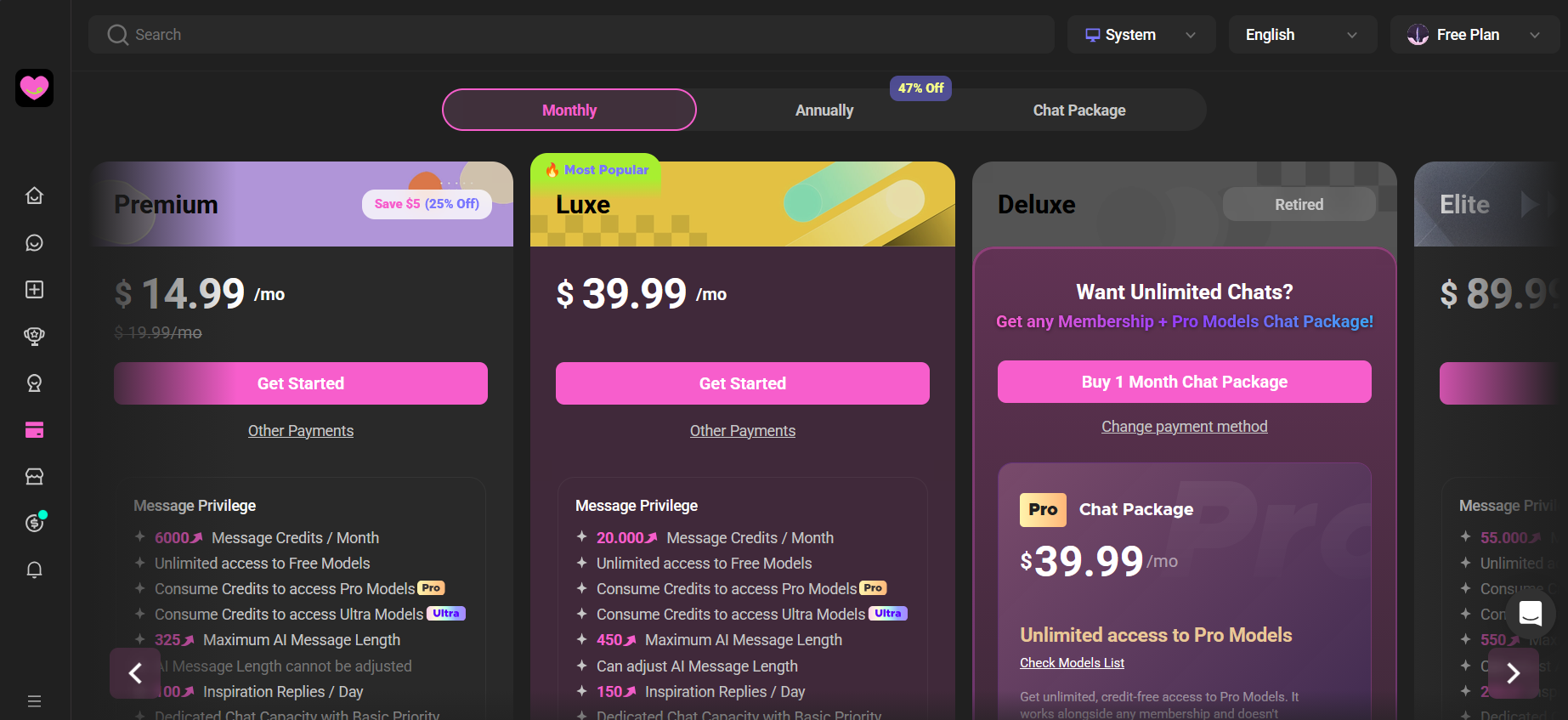
Pricing updated: September 2, 2026
| Plan | Monthly Price | Annual (effective/mo) | What You Get |
|---|---|---|---|
| Free | $0 | — | ~50 messages/day, basic memory, limited chat history, ads, slower responses |
| Standard | $5.99 | ~$4.19/mo | 2,000 messages/month, group chat access, longer history (~300 msgs/character), faster responses |
| Premium | $14.99 | ~$10.49/mo | 6,000 messages/month, extended memory, dedicated capacity, smoother peak‑hour performance |
| Luxe | $39.99 | ~$25/mo | 20,000 message credits/month, longer message length, more inspiration replies, higher customization limits |
| Deluxe (Unlimited) | $49.99 | ~$34.93/mo | Unlimited messaging, max memory, immersion features, response‑length control, up to 100 characters |
| Elite / High‑Volume | $199.99 | varies | Extremely high message limits, advanced features, built for heavy or professional users |
Annual plans usually reduce the monthly cost by 30–60%
Messaging limits vary by tier; heavy roleplay users should choose higher plans
The free tier is fine for testing but too limited for regular roleplay
CrushOn AI does have a free tier, but anyone who uses the platform more than casually will end up on one of the paid plans. The cheaper rates only show up when you switch to annual billing, so it’s worth checking the live pricing instead of assuming the monthly number matches the annual breakdown. The free plan is fine for getting a feel for the platform, but the limits kick in quickly — short chat history, slower responses, and fewer characters to interact with.
Most people settle into the Standard or Premium plans because they unlock longer conversations, better memory, and smoother performance during busy hours. If you spend a lot of time in immersive roleplay or you run multiple characters, the Deluxe and Unlimited tiers make a noticeable difference. They remove most of the friction and give you more control over message length and how much the AI can remember. The Elite tier is really only for heavy users or creators who need the extra capacity.
What exactly is CrushOn AI?
CrushOn AI is a chat platform built around character‑based conversations and roleplay. It focuses heavily on realism, personality depth, and NSFW freedom, which is why it’s often compared to apps like Candy AI, Kindroid, and Janitor AI.
Is CrushOn AI free to use?
Yes, there’s a free tier, but it’s very limited. You can test the platform, but message caps and shorter chat history make it hard to use consistently. Most people end up on a paid plan once they start using it regularly.
How much does CrushOn AI cost?
CrushOn AI uses a subscription model with different message limits depending on the plan. Annual billing usually drops the monthly cost quite a bit. The higher tiers unlock longer messages, better memory, and smoother performance during busy hours.
Does CrushOn AI allow NSFW content?
Yes. CrushOn AI is one of the more permissive platforms in this space, which is why it’s popular for adult roleplay. The experience varies depending on the character and the plan you’re on, but NSFW content is supported.
How realistic are the conversations?
CrushOn AI leans heavily into emotional tone, personality consistency, and immersive responses. It’s not perfect, but it’s noticeably more expressive than many mainstream AI chat apps. Higher tiers improve memory and message length, which helps with realism.
Which plan is best for most users?
Most people land on Standard or Premium because they offer enough message volume and memory for regular use. If you spend a lot of time in long roleplay sessions, the Deluxe or Unlimited tiers feel smoother and more consistent.
Is CrushOn AI worth paying for?
If you use it casually, the free tier is fine. If you use it for daily conversations or roleplay, the paid plans make a big difference — longer messages, better memory, and fewer interruptions. It depends on how often you chat and what you use it for.
Final verdict
CrushOn AI is one of those platforms that feels straightforward at first, but the more time you spend with it, the more you notice what it’s actually built for: long, expressive, often intimate conversations that don’t hit the usual roadblocks. It’s not the most polished app in the space, and it doesn’t try to be. What it does well is give you characters that stay in the moment, respond with personality, and keep the energy of a roleplay going without constantly derailing the tone.
The free tier is enough to get a feel for how the platform works, but the real experience starts once you move into the paid plans. Longer messages, better memory, and smoother performance make a noticeable difference — especially if you’re someone who enjoys deeper or more immersive chats. CrushOn AI isn’t perfect, and it won’t suit everyone, but for users who want freedom, expression, and a platform that doesn’t shy away from adult themes, it delivers exactly what it promises.
If your priority is realism, emotional tone, and uninterrupted roleplay, CrushOn AI is one of the stronger options in this category. If you prefer a more polished interface or a companion that leans toward structured personality development, you may find better fits elsewhere. But for raw conversational flow and creative freedom, CrushOn AI holds its ground.
Affiliate Disclosure: This website contains affiliate links, which means I may receive a small commission if you sign up through a link on this page. This comes at no extra cost to you and helps support the website. My reviews and recommendations are based on my own research and opinions.
About the Founder: Simon Norman
I built AI Companion Kit to be an independent AI companion hub focused on transparent research, practical insights, and honest evaluations of AI companion platforms. My goal is to help readers understand how these apps work, what makes them different, and which features actually matter before they make a decision.
To learn more about who is behind AI Companion Kit, my research process, and the editorial standards used across the site, visit About the Founder (Simon Norman).