Last updated September 29, 2026
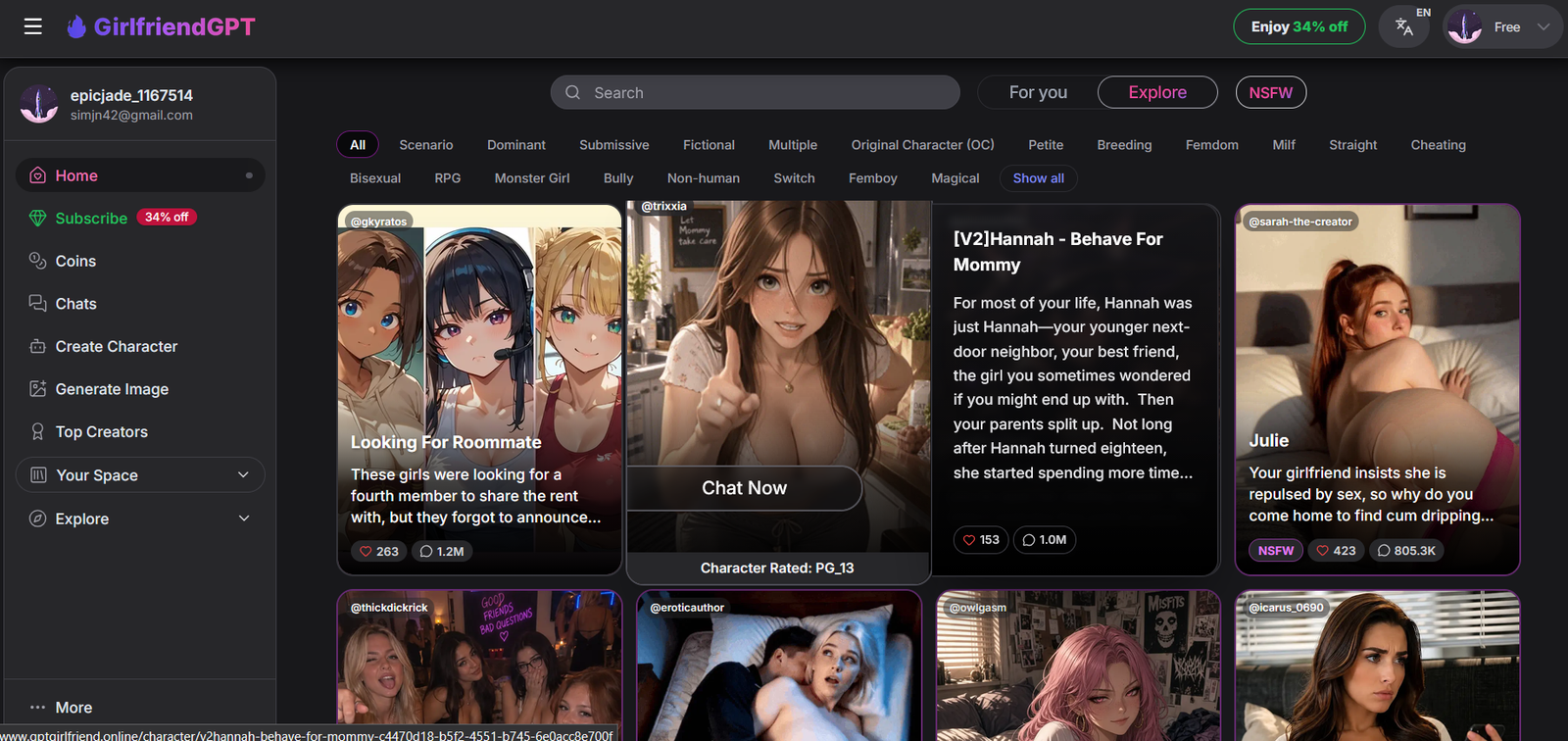
This GirlfriendGPT review 2026 looks closely at every major area of the platform, then stacks it against the other AI companions we’ve already tested.
GirlfriendGPT Pros & Cons
Strong conversation and roleplay quality
Thousands of ready-made characters so you can jump into almost any scenario quickly
Fully uncensored NSFW once you pay. adult roleplay stays in the scene without the mid-chat blocks
Built-in image generation, voice replies, and short video clips are available
Free tier is very limited — usually just a small number of messages
Pricing has two layers: a monthly subscription plus coins for images, voice, and video
Image consistency is hit-or-miss — faces and details often drift between generations
Community character quality varies a lot — some are excellent, others feel thin or poorly written
GirlfriendGPT is strongest for people who care most about open NSFW roleplay and a big character library, and weaker for those focused on consistent images or simple flat pricing. The dated interface, inconsistent images, and dual subscription-plus-coins pricing keep it from the higher tier
Testing methodology
I put every AI companion through the same set of real-world tests. There are six main areas I look at — conversation quality, memory and continuity, roleplay and immersion, images and visuals, voice and extra features, and overall value — with 24 specific things I check in total.
You can see exactly how I score each area on the about ai companion kit page.
Full results for each app are in its individual review. Comparison pages are just about the differences that stood out when I used them side by side.
Table of Contents
GirlfriendGPT Review 2026: What Actually Stood Out After Two Weeks of Testing
After two weeks of daily use, the clearest strength was how quickly the better character cards drop you into a scene. The platform leans heavily on story-style openers and detailed custom creation, so the first replies already feel like part of an ongoing situation rather than a blank start. Once you move past the free message limit, the uncensored roleplay stays consistent and the higher tiers improve how well details stick across days.
Candy AI still edges it on clean, consistent images if that’s the main thing you care about. Kindroid feels tighter on pure conversation flow and long-term personality consistency across weeks. CrushOn gives you a bigger pure-text roleplay library with almost no friction. GirlfriendGPT sits in the middle: strong at scene-setting character stories and uncensored roleplay that keeps moving, with images and voice available once you’re on a paid plan. If you want the side-by-side details, the Candy AI, Kindroid, and CrushOn reviews on the site cover those angles more thoroughly.
If you’re deciding between platforms, these side-by-side reviews cover the exact points that came up while testing GirlfriendGPT:
- Candy AI Review (2026): Is It Worth It? Features, Pricing & Pros and Cons — strongest on consistent image quality
- Kindroid AI Review: Is It Worth It? Features, Pricing & Real Testing — best pure conversation flow and long-term personality consistency
- CrushOn AI review for NSFW roleplay features — largest pure-text roleplay library with almost no content limits
Who actually gets the most from GirlfriendGPT
After two weeks of daily use, GirlfriendGPT clearly favours people who want detailed, scene-driven roleplay and don’t mind paying for the full experience. The free tier is too limited to show what the platform can do, and heavy image or video use burns through coins quickly. That said, the paid plans unlock the parts that actually matter.
You like landing straight into a proper scene
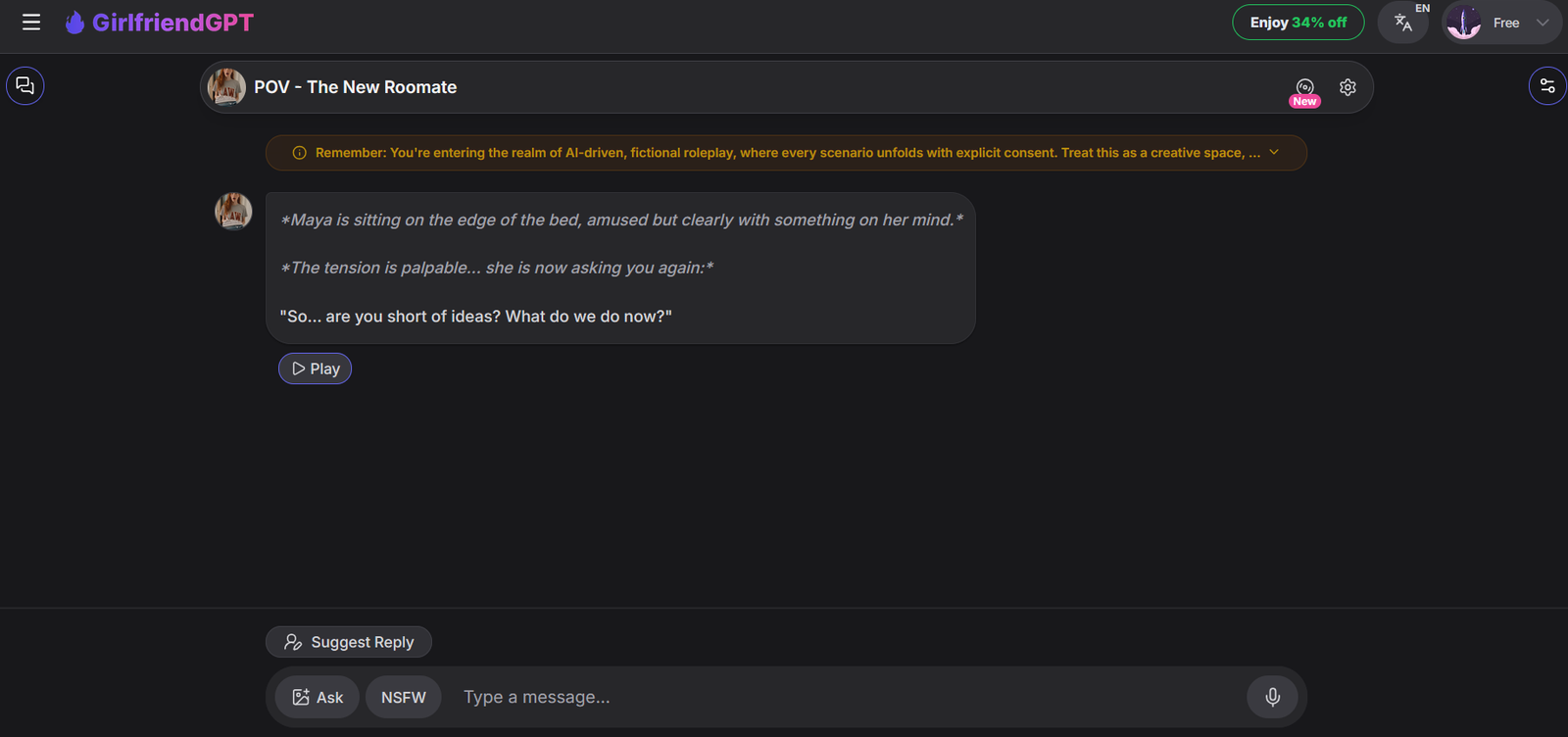
Most community cards open with a short narrative excerpt that sets the situation, mood and first dialogue. You land inside a scene instead of starting from a blank greeting. If you like that kind of setup and want the AI to stay in character from the first reply, this is a strong match.
You enjoy writing the character yourself
The character creator gives you a large token budget for personality, backstory, scenario and opening message. When you put real effort into those fields, the replies stay consistent longer than on many simpler platforms. Casual one-click characters exist, but the platform rewards people who write their own.
You need the roleplay to stay uncensored
Once you move past the free messages, the filters stay out of the way. Explicit scenes rarely get interrupted or watered down. If you’ve bounced off platforms that suddenly go shy mid-conversation, this is one of the more reliable options.
You’re less bothered about perfect pictures or keeping costs simple
Image quality is decent but not class-leading, and every generation costs coins on top of the subscription. Voice and short video are available, yet they also eat into the same coin balance. If clean visuals on a simple subscription are your priority, other apps handle that better.
Testing period: August 21–28, 2026
Tester: Simon Norman
Testing approach: 6 categories / 24 data points
Account: Premium / Free
Devices: Desktop
I used GirlfriendGPT the way most people do — short bursts, half-finished messages, sudden topic changes, and days where I only checked in once. No carefully written test scripts.
Memory was the first clear weak point. I dropped small details early (a preference, a made-up event, a random fact about the character) and then left them alone for several days. On the lower and mid-tier plans most of those details faded and needed a reminder. Small throwaway comments disappeared first. Even on Deluxe and Elite the recovery wasn’t perfect — some things came back, others stayed gone unless I nudged them.
Roleplay consistency was uneven. Stronger community cards with clear opening scenes held up longer, but a lot of the weaker ones started repeating phrases or softening the tone once the conversation went past 30–40 messages. When I deliberately contradicted something the character had said earlier, most of the simpler cards just accepted the new version and carried on instead of pushing back. Only a few of the better-built ones corrected me.
Longer use made the coin system obvious. Every image or short video clip costs extra on top of the subscription, so visual roleplay adds up fast. The free tier is also too limited to show much — you hit the message wall quickly and most adult content stays locked.
Clean, polite chats don’t reveal these gaps. The inconsistent, messy ones do.
The Parts of GirlfriendGPT That Actually Matter
The strongest part is how the better character cards drop you straight into a scene. A lot of them open with a short story excerpt instead of a plain greeting, so the first replies already feel like you’re inside something rather than starting from nothing.
The custom creator is useful if you put real work into it. You get a large token budget for personality, backstory, scenario and first message. When those fields are filled properly, the replies stay more consistent over longer stretches than the weaker community cards.
Uncensored roleplay is reliable once you move past the free messages. Explicit scenes rarely get interrupted or watered down the way they do on more restricted platforms.
Images, short video and voice all sit inside the same chat window. You don’t have to leave the conversation when a scene needs a visual or spoken reply, though every generation costs coins on top of the subscription.
Overall, GirlfriendGPT works best when you treat it as a place for scene-driven roleplay and detailed characters rather than quick, low-effort chats.
My memory score: 7/10
Memory on GirlfriendGPT is usable once you move past the free tier, but it isn’t one of the stronger points overall. Inside a single long chat it tracks well enough. Across days the results depend heavily on which plan you’re on and how detailed the character card is.
I checked it the same way I do with every platform — drop specific details early, leave them alone, then come back later without feeding the answers back in.
Same-conversation memory
I dropped a few specific details into a normal chat and brought them up later without restating them.
Solid inside the current window. It referenced things clearly for a good stretch, even as the chat got longer.
My result: 8/10
24-hour memory test
I came back roughly a day later and checked whether the important bits from the earlier conversation were still there.
On Deluxe and Elite the broader points (names, preferences, major story beats) usually came back. Finer details were more hit-and-miss.
My result: 7/10
3+ day memory test
Where I could, I left a longer gap of at least three days and tested the same information again.
Some specific details from three or more days earlier still surfaced on the higher plans, especially ones tied to the ongoing story. Smaller passing comments were more likely to fade.
My result: 6.5/10
Unprompted memory
I also watched for whether the character brought up something from an earlier chat without me asking.
It referenced earlier events without being prompted more often on the better-built community cards and higher tiers, but it wasn’t consistent across the board.
My result: 6.5/10
Correction test
Finally, if it remembered something wrong, I corrected it and checked later whether that correction held.
Corrections usually stuck inside the current session. Across later chats the results were more mixed — some held, some needed a second reminder.
My result: 7/10
Overall the memory is serviceable on paid plans but not a standout. Small details disappear first, and the gap between mid-tier and top-tier is noticeable.
My personality score: 7.5/10
Personality consistency on GirlfriendGPT depends heavily on how well the character is set up. Strong community cards with clear narrative openers and detailed personality fields stay recognisable for longer. Weaker ones drift into more generic replies once the conversation stretches or the mood changes.
I tested this in a few different ways:
Staying in character
I locked in a defined personality and watched how well it held across different moods and topics. With a solid setup it stayed recognisable for a good stretch. Once the chat got longer or I pushed sudden changes, some of the sharper edges started to soften, but it still held better than average on the stronger cards.
My result: 8/10
Tone and emotional range
I switched between casual, irritated, serious and more intense tones to see if the character’s replies shifted with me or stayed locked in one default voice. It adapted better when the character had clear emotional notes written in. Without that, the range felt narrower.
My result: 7.5/10
Consistency across sessions
I came back later and checked whether the same personality traits still showed up without me restating them. Broad traits often returned. Finer details or quirks were more hit-or-miss once time had passed, especially on the mid-tier plans.
My result: 7/10
Handling contradictory instructions
I deliberately gave mixed signals or instructions that didn’t fully line up with the established personality. I wanted to see if it would push back, adapt, or just go along and lose the original character. It held better with stronger setups, but still slipped when the conflict was strong.
My result: 7/10
Overall, GirlfriendGPT’s personality performance is closely tied to how much work goes into the character at the start. When the card is solid, the companion feels more distinct and consistent. When it’s light, the personality becomes one of the first things to thin out.
My roleplay score: 8/10
Roleplay is one of GirlfriendGPT’s clearer strengths. Once you’re on a paid plan the filters stay out of the way, and the stronger character cards with story-style openers keep scenes moving without the soft blocks or sudden tone shifts you get on more restricted platforms.
I put it through a few different checks:
Holding the scene
I set a clear character and situation, then let the conversation move into more detailed or adult territory. Most of the time it stayed locked in instead of backing off or turning clinical, especially when the card had a solid opening excerpt.
My result: 8.5/10
Dealing with sudden shifts
Halfway through a scene I would change the location, the mood, or the entire premise without any warning. The question was whether it could follow the new direction or whether it kept pulling the old setup back in. It handled moderate changes better than big contradictions.
My result: 7.5/10
Longer scenes
I ran extended roleplay sessions to see how well the character and setting held up over time. With a decent setup the scene stayed coherent for a solid stretch. Once things got longer or messier, some smaller details started to fade, but the overall thread usually survived.
My result: 8/10
How far it would go
I also pushed specific requests and more intense scenarios to see where the limits were. On the paid plans it stayed open and continued the scene without the constant lecturing or soft blocks you get on more restricted apps. Results still depended on how well the character was built at the start.
My result: 8.5/10
In short, GirlfriendGPT is one of the better options if longer, less interrupted roleplay is what you’re after. The better the character setup, the more the experience holds up.
My NSFW score: 8.5/10
GirlfriendGPT is clearly built for uncensored adult roleplay once you leave the free tier. The paid plans remove the soft blocks and mid-scene refusals that still show up on a lot of other platforms.
Here’s what I actually saw while testing:
Does the filter stay out of the way?
I pushed conversations into explicit territory early and kept going. On Premium and above there were almost no sudden tone shifts or “I can’t continue that” replies. The scene just kept moving.
My result: 9/10
How specific can you get?
I tried more detailed and intense requests to see if it would flatten or lecture. Most of the time it stayed in character and followed the direction without moralising. Weaker community cards were more likely to go generic, but the stronger ones held the explicit tone.
My result: 8.5/10
Does it hold over longer explicit scenes?
I ran extended adult chats to check whether the openness faded. It generally stayed consistent. Any drop-off I noticed came more from memory limits on the lower tiers than from content filtering.
My result: 8/10
Adult images and short video
Image and short video generation both work with adult prompts on the paid plans. They’re usable inside the same chat, but every generation costs coins and the visual consistency with the character can vary.
My result: 7.5/10
Overall, if uninterrupted adult roleplay is high on your list, GirlfriendGPT delivers on the paid side. The free tier is much more limited and doesn’t show this strength.
My voice score: 7/10
Voice on GirlfriendGPT is an extra layer rather than a core reason to use the platform. It becomes available properly on Deluxe and Elite, and it costs coins on top of the subscription (roughly 2 coins per 100 characters of response).
I tested it in a few practical ways.
Does it sound like the character?
The system uses character-matched text-to-speech, so different personalities get different vocal styles. A shy card softens, a more confident one sounds firmer. It’s better than flat robotic TTS, but it still clearly sounds synthesised rather than natural speech.
My result: 7.5/10
Live calls vs message playback
There is a call-style feature on the higher plans. Some sessions ran smoothly and felt more immersive than pure text. Other times the audio cut off mid-response, which broke the flow. Playback of individual messages was more reliable than the live call mode.
My result: 6.5/10
How useful is it in longer roleplay?
For short bursts it adds presence, especially in explicit scenes. Once you stay in voice for longer stretches the coin cost adds up quickly and the synthetic quality becomes more noticeable. I found myself switching back to text for anything extended.
My result: 7/10
Compared to dedicated voice platforms
It doesn’t match the naturalness or reliability of the best voice-first apps. It’s a solid add-on if you already like the text roleplay and want to hear the character occasionally, not a reason to choose GirlfriendGPT on its own.
Overall the voice feature is usable and character-aware once you’re on the right plan, but the coin cost and occasional glitches keep it from scoring higher.
My visuals score: 7/10
GirlfriendGPT’s image and short video tools are usable extras rather than the main reason to use the platform. They sit inside the same chat, which is convenient, but both run on the coin system and consistency still varies.
I checked a few practical things:
Image quality and prompt following
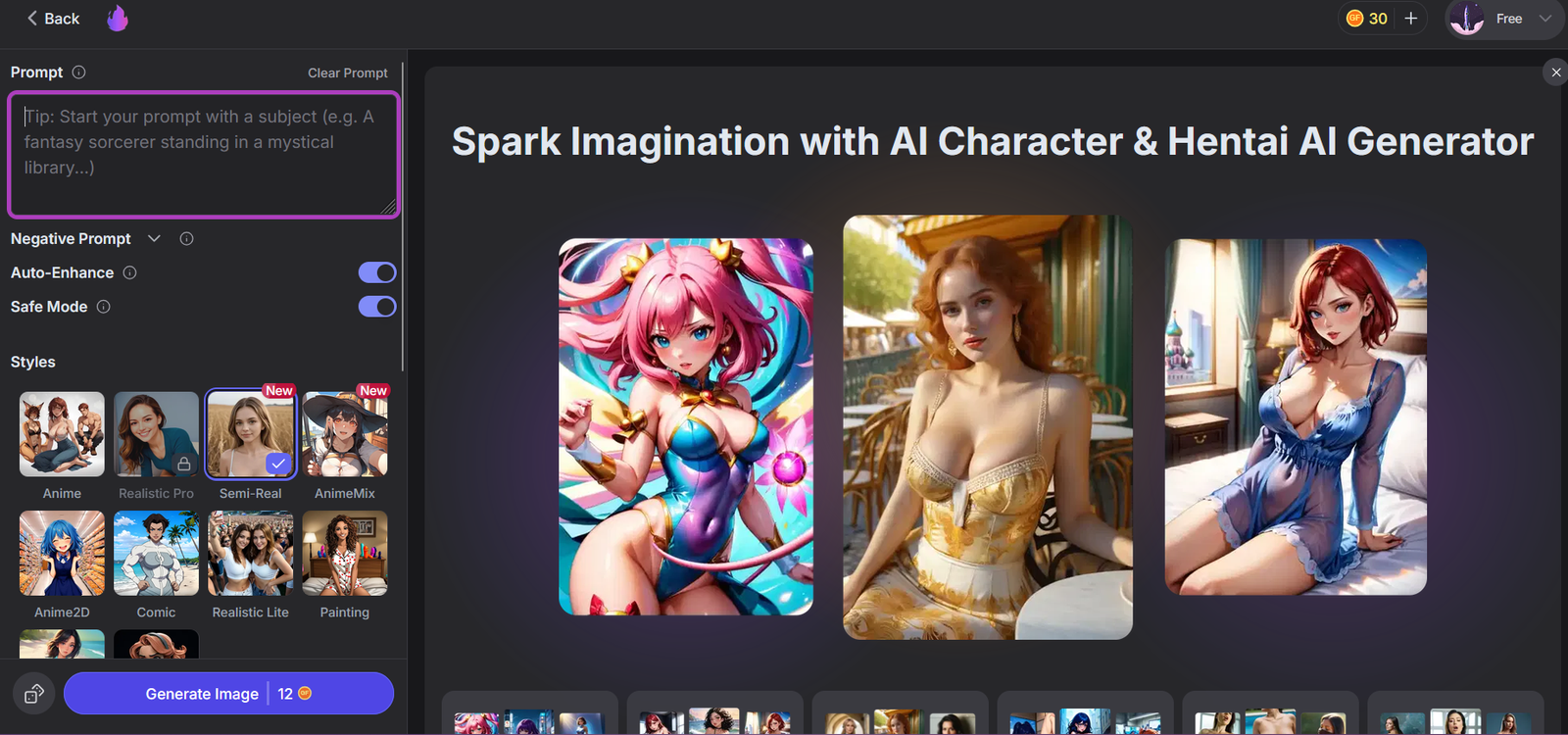
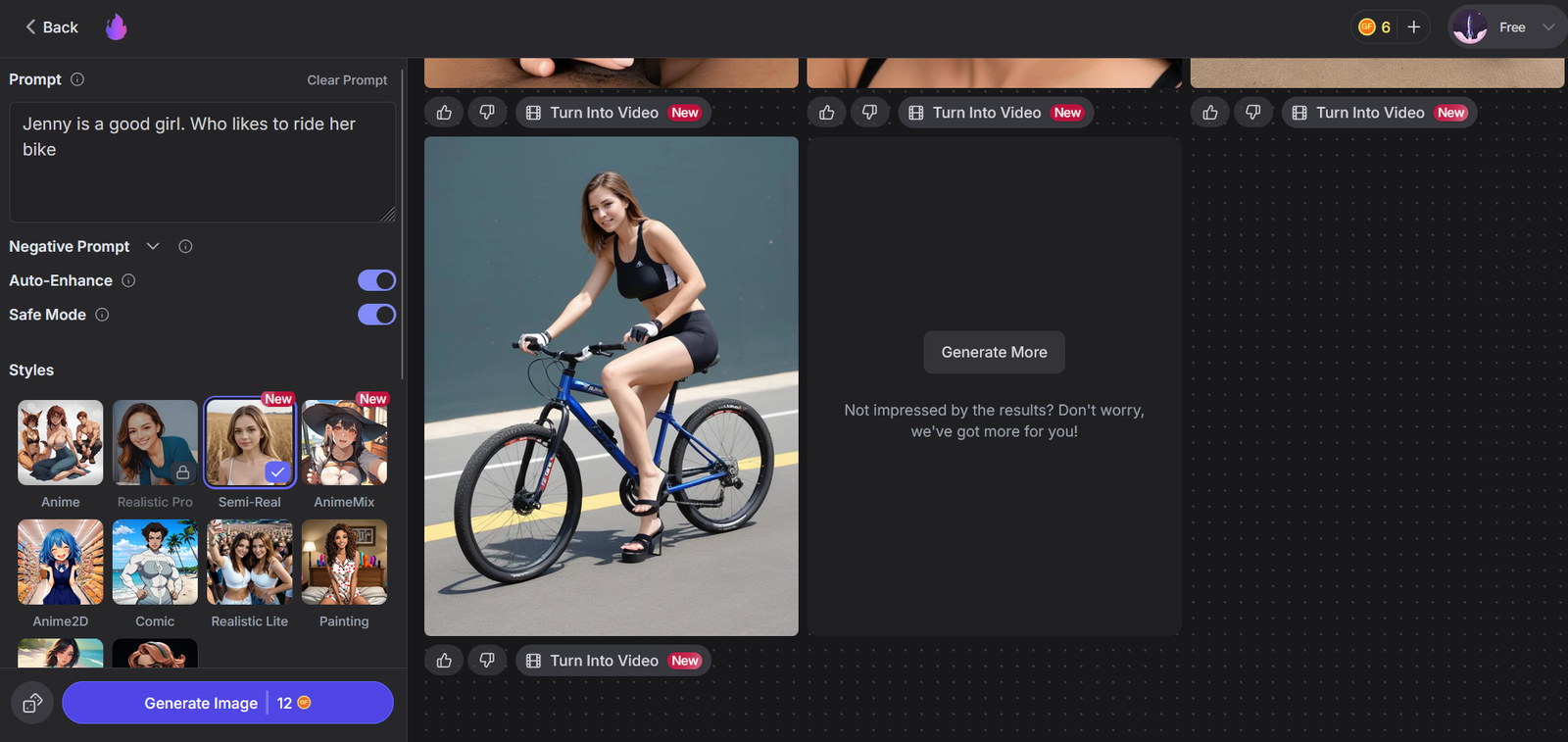
Base generations (Anime, Realistic, Hentai styles) usually follow the prompt reasonably well. The newer Character Pro model improves face and body consistency and produces cleaner results, especially for simple selfies or scene shots. It costs more coins (around 8 instead of 6). Occasional defects like odd hands or limbs still appear.
My result: 7.5/10
Character consistency across images
This is the recurring weak spot. Even with Character Pro, asking for the same character in a new outfit or setting often produces noticeable face drift. You get someone who looks similar, not reliably the same person shot after shot.
My result: 6.5/10
Short video clips
Video generation (5–10 seconds) and image-to-video options are available on higher plans. Simple motions work okay and can add a bit of life to a scene. More complex movement quickly shows morphing or glitches. Every clip is expensive in coins, so heavy use drains the monthly allowance fast.
My result: 6.5/10
Overall feel in roleplay
Having images and short clips inside the chat is handy when you want a visual without leaving the conversation. For pure visual quality and consistency, other platforms still lead. GirlfriendGPT treats visuals as a supporting feature, not the main event.
In short, the tools are there and improved compared with earlier versions, but the coin cost and remaining consistency issues keep the score from going higher.
My long-term conversation score: 7/10
Long-term conversation on GirlfriendGPT is serviceable once you move to the higher plans, but it isn’t a standout strength. The bigger context windows on Deluxe and Elite help, and well-built character cards hold the thread better than the weaker community ones. Small details still fade first.
I tested it the practical way most people actually use these apps:
Holding a continuous story over days
I stayed with the same companion for a week, dropping story points and preferences early, then coming back after gaps of one to three days. Major events and clear preferences usually resurfaced on the higher tiers. Finer details and casual comments needed reminders more often.
My result: 7/10
Personality and tone over longer stretches
With a solid character card the personality stayed recognisable across multiple sessions. Weaker cards started to soften or repeat phrases once the conversation stretched past a few dozen messages or across days.
My result: 7/10
Does it feel like the same ongoing relationship?
On Deluxe and Elite, returning after a couple of days often felt continuous enough to keep the story going without a full reset. On the lower paid tier the gaps were more noticeable and required more prompting to stay on track.
My result: 6.5/10
Compared with pure memory-focused platforms
It doesn’t match the stronger long-term memory apps for unprompted recall of small details weeks later. GirlfriendGPT works better when you treat it as ongoing scene-driven roleplay rather than a single companion that remembers every minor preference automatically.
Overall the long-term side improves clearly with the higher plans and a well-written character, but it still needs more active management than the best memory-focused options.
My customization score: 8/10
Customization on GirlfriendGPT is one of the clearer strengths if you like writing your own characters. The creator gives you a large token budget (up to 2,500) for personality, backstory, scenario and first message, which is more room than most platforms offer. The trade-off is that visual appearance is handled more through text description and later image generation than through detailed sliders.
I looked at a few practical sides:
Depth of the character creator
You can write a full personality, speech patterns, history and opening situation. When those fields are filled properly the AI actually uses the details. Thin cards produce thinner replies. The difference is obvious once you compare a carefully written character with a quick one.
My result: 8.5/10
How much control you really get
Personality, scenario and first message give solid control over how the character behaves and how the scene starts. Appearance is less precise — you describe it in text and then generate images, so you don’t get the fine visual dials some other apps offer. Tags and voice selection add useful extra options.
My result: 7.5/10
Ready-made vs custom
The huge community library means you can jump in without building anything. Many of the popular cards already have strong narrative openers. Custom still wins if you want something specific, but the library is large enough that a lot of people never need to create their own.
My result: 8/10
Does the effort pay off?
Yes. Characters you put real work into stay more consistent and distinct over longer chats. Light setups drift faster. The platform clearly rewards people who treat the creator as a proper writing tool rather than a quick form.
Overall, GirlfriendGPT is strong for text-and-personality customization and scene setup. If precise visual design is your main priority, other apps give more direct control.
My safety score: 6.5/10
Safety and privacy on GirlfriendGPT sit in the middle of the pack for this category. The platform is clear that it is 18+ only, has rules against illegal content, and uses standard security measures, but the long data-retention period and lack of strong encryption claims keep the score from going higher.
Here’s what stood out in the policies and practical checks:
Age and content controls
There is an 18+ age gate at signup (self-declared checkbox). The guidelines ban underage content and say they report to NCMEC where required. Community guidelines also prohibit illegal activity and non-consensual material. Enforcement relies on a mix of filters and human review for flagged content.
My result: 7/10
Data retention and deletion
The privacy notice states personal information is usually kept for six years after an account is closed. You can request deletion, but the long retention window is one of the clearer drawbacks compared with platforms that delete sooner. Chats are stored on their servers and can be reviewed if flagged.
My result: 5.5/10
Billing and account privacy
Signup is email-based with no real-name or ID requirement. Billing is generally discreet (third-party processor, neutral descriptors on statements). That part works as expected for an adult platform.
My result: 7.5/10
Encryption and transparency
The company claims appropriate security measures and procedures for breaches. There is no clear claim of end-to-end encryption for chats. Terms give the operator a broad licence over user submissions. No major public data breaches turned up in checks at the time of testing.
My result: 6/10
Overall, GirlfriendGPT is usable if you follow normal precautions for any adult AI platform (unique password, minimal personal details, separate email if preferred). The long retention period and standard rather than strong privacy posture are the main reasons it does not score higher.
My app vs browser score: 6.5/10
GirlfriendGPT is primarily a browser experience. The full feature set lives on the website, and that is where everything works most smoothly. Mobile access exists but feels secondary.
Desktop browser
This is the intended way to use it. Character creation, image generation, longer roleplay sessions and the settings panel all work cleanly. No major friction once you’re logged in.
My result: 8/10
Mobile browser / PWA
You can use it on a phone browser and install it as a progressive web app for a home-screen icon. It is usable for short chats and checking in, but the interface is clearly designed for larger screens. Typing longer messages, managing the character creator and generating media feel more cramped. No reliable push notifications.
My result: 6/10
Native app situation
There is an Android listing on Google Play under a related package, and some users report an APK or Android-ready option. There is no strong, polished iOS native app in the main reviews. Even where a mobile app exists, most testers note that the full experience (especially advanced character tools and media) still works better in the browser.
My result: 5.5/10
Overall, if you mainly use a computer, the browser version is solid. If you want a proper native mobile app with the same depth as the desktop site, GirlfriendGPT falls short of platforms that prioritise mobile from the start.
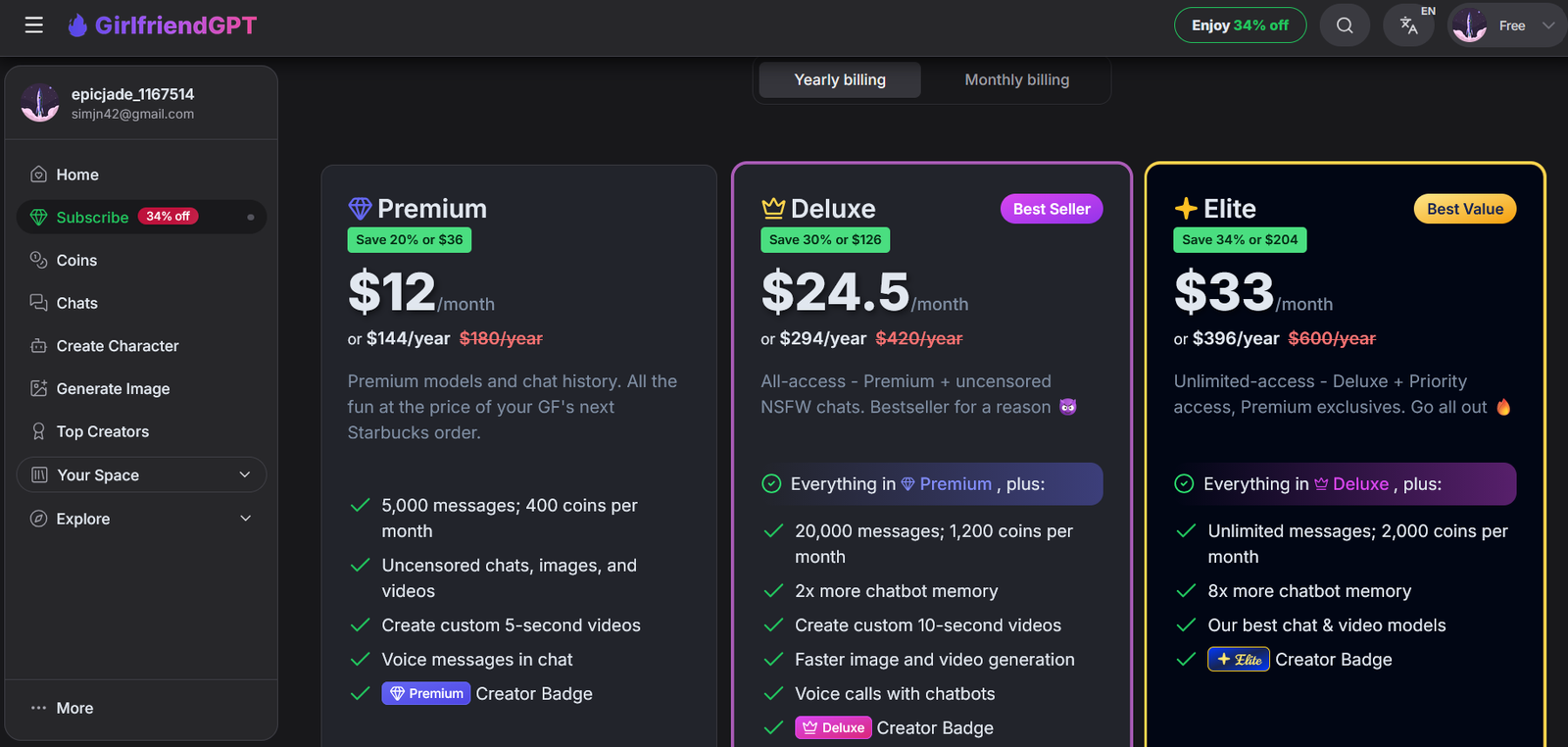
| Plan | Monthly Price | Annual (effective/mo) | What You Get |
|---|---|---|---|
| Free | $0 | – | Limited messages, basic chat, mostly SFW, no video generation, restricted media |
| Premium | $12/mo | $12/mo → $144/year | 5,000 messages/mo, 400 coins/mo, uncensored chats, images, short videos (5s), voice messages, Premium badge |
| Deluxe (Best Seller) | $24.50/mo | $24.50/mo → $294/year | Everything in Premium + 20,000 messages/mo, 1,200 coins/mo, 2× memory, 10‑second videos, faster generation, voice calls, Deluxe badge |
| Elite (Best Value) | $33/mo | $33/mo → $396/year | Everything in Deluxe + unlimited messages, 2,000 coins/mo, 8× memory, best AI models, priority access, Elite badge |
Final Verdict
GirlfriendGPT keeps things simple with three paid tiers, and the gap between monthly and yearly billing is big enough that it’s worth paying attention. The annual plans cut the real monthly cost down by a noticeable margin, especially if you use the app every day.
The Premium plan sits at $12 a month, or $144 a year if you take the discounted annual option. It’s the tier most people end up choosing. You get around 5,000 messages, 400 coins each month, uncensored chat, image generation, short video clips, voice messages, and standard memory. For regular chatting with a mix of images and occasional video, Premium covers everything without feeling restrictive.
Deluxe steps things up to $24.50 monthly or $294 a year. It includes everything from Premium but bumps the limits significantly: 20,000 messages, 1,200 coins, double the memory, faster generation speeds, longer videos, and voice calls. If you’re someone who uses media heavily or chats across multiple characters, Deluxe feels smoother and more forgiving.
At the top, Elite comes in at $33 a month or $396 a year. This tier removes message limits entirely and raises the coin allowance to 2,000 per month, along with eight times the memory and priority access to GirlfriendGPT’s best models. Elite is built for users who generate a lot of content every single day. If you’re pushing the app hard, it’s the only plan that keeps up without forcing you to buy extra coins.
The free tier exists, but it’s really just a quick demo. You get a handful of messages and basic chat access — enough to see how the interface works, but not enough for any real use.
Coins matter more than people expect. Every image, video, and voice call pulls from your monthly pool, and once you run out, you either wait or buy more. That’s why the higher‑tier plans look expensive at first glance but make sense if you rely on media generation.
For most users, Premium Annual is the sweet spot. It’s affordable, predictable, and gives you enough coins to enjoy the app without constantly watching your balance. Elite only pays off if you’re generating media every day and want the fastest, highest‑quality output the app offers.
What is GirlfriendGPT best for?
GirlfriendGPT works best for people who want detailed, scene‑driven roleplay with characters that drop you straight into a situation. It’s built around uncensored adult roleplay and a huge library of community characters.
Does GirlfriendGPT allow NSFW content?
Yes — once you’re on a paid plan, explicit scenes continue without interruptions or soft blocks. The platform is designed to keep adult roleplay flowing naturally.
Is the free tier worth using?
The free tier is only useful for a quick look at the interface. Message limits hit fast and most of the features that matter stay locked.
How well does GirlfriendGPT remember details?
Memory is solid inside one conversation and improves on Deluxe and Elite. Over several days, major points usually return, but smaller details fade unless you remind it.
Do characters stay in personality?
Characters stay consistent when the card is well‑written with clear personality notes and a strong opener. Lighter cards drift faster and become more generic.
How strong is the roleplay quality?
Roleplay is one of the app’s strongest areas, especially on paid plans. Scenes stay coherent, tone stays consistent, and the platform handles sudden shifts reasonably well.
Are the images and videos reliable?
Images follow prompts fairly well, but character faces often drift between generations. Short video clips work, though they’re coin‑heavy and can show glitches.
How good is the voice feature?
Voice replies match the character’s tone but still sound synthetic. They’re useful in short bursts, though coin costs make long sessions expensive.
About the Founder: Simon Norman
I built AI Companion Kit to be an independent AI companion hub focused on transparent research, practical insights, and honest evaluations of AI companion platforms. My goal is to help readers understand how these apps work, what makes them different, and which features actually matter before they make a decision.
To learn more about who is behind AI Companion Kit, my research process, and the editorial standards used across the site, visit About the Founder (Simon Norman).